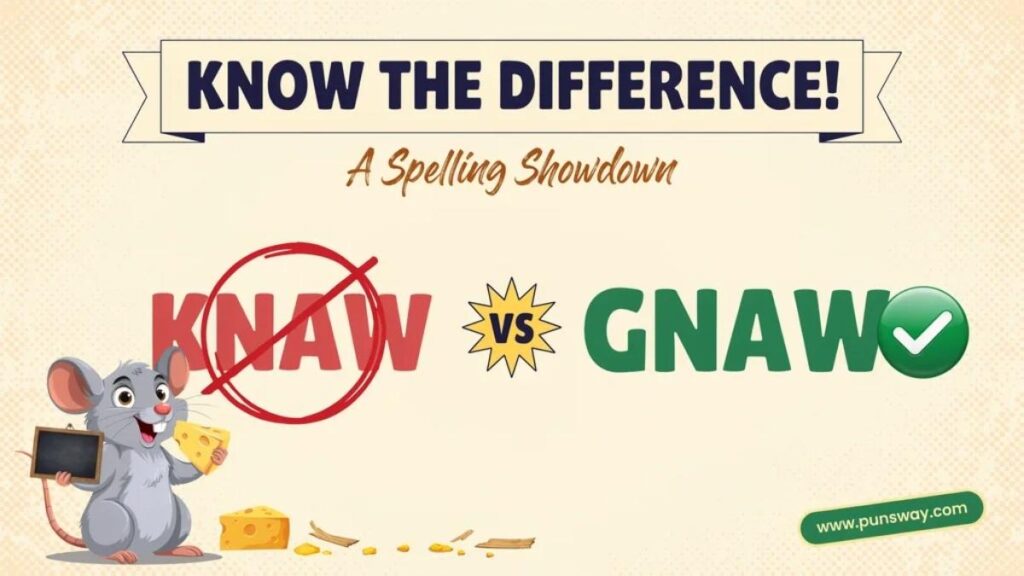
Have you ever wondered whether the correct spelling is knaw vs gnaw? If so, you’re not alone. Many people get confused because both words sound the same when you say them. English is full of tricky silent letters, and the silent G in gnaw is one of them. Its like a quiet friend who comes to every party but never says a word. The good news is that the rule is easy to remember. In this guide, you well earn the correct spelling, the meaning of gnaw, how to pronounce it, how to use it in sentences, common mistakes to avoid, and simple tips to help you spell it correctly every time.
Knaw vs Gnaw Quick Answer
If you are asking, “Knaw vs gnaw which is correct?” the answer is straightforward Gnaw vs Know.
Gnaw is the only correct spelling in modern English.
Knaw is not recognized as a standard English word. Instead, it is a common spelling mistake caused by pronunciation confusion and the unusual spelling patterns found in English.
Here’s a quick comparison.
| Feature | Gnaw | Knaw |
|---|---|---|
| Correct English spelling | Yes | No |
| Found in dictionaries | Yes | No |
| Part of speech | Verb | Not an English word |
| Used in formal writing | Yes | No |
| Accepted in American English | Yes | No |
| Accepted in British English | Yes | No |
Whenever you are unsure how to spell gnaw, remember that the word always begins with a silent G.
Knaw vs Gnaw at a Glance
Many people type knaw because they write the word exactly as they hear it. However, pronunciation does not always match spelling in English Gnaw vs Know.
Here’s a closer comparison.
| Comparison | Gnaw | Knaw |
|---|---|---|
| Pronunciation | Naw | Naw |
| Dictionary status | Standard English word | Misspelling |
| Grammar | Correct verb | Incorrect |
| Common in books and newspapers | Yes | No |
| Appropriate for academic writing | Yes | No |
The difference between knaw vs gnaw comes from one of the trickiest parts of English spelling: silent letters.
Several common words contain silent letters that aren’t pronounced.
- Gnat
- Gnome
- Gnash
- Know
- Knee
- Knife
- Knot
Just because you don’t hear the G doesn’t mean it disappears from the spelling.
Laughter looks good on you find more clever jokes
Ingage vs Engage Difference and usage
What Does Gnaw Mean?
Understanding the gnaw meaning makes it much easier to remember the correct spelling and use the word naturally.
The gnaw definition is simple.
Gnaw means to bite or chew something repeatedly over a period of time. It can also describe a feeling that slowly troubles or worries someone Gnaw vs Know.
In other words, the word has both a literal meaning and a figurative meaning.
Literal Meaning
The literal meaning describes repeated chewing or biting.
Animals often gnaw because they need to wear down their continuously growing teeth. Rodents are especially known for this behavior.
Examples include:
- The dog gnawed the bone all afternoon.
- A mouse gnawed through the wooden box.
- The beaver gnawed the tree trunk until it fell.
- Rabbits sometimes gnaw furniture when they feel bored.
- Rats can gnaw through plastic, wood, and even thin metal.
Notice that each example describes persistent chewing rather than a single bite.
This makes gnaw different from words like bite or nibble. A bite usually happens once, while gnaw describes repeated action.
Figurative Meaning
The word also appears in emotional situations.
Instead of describing teeth damaging an object, gnaw refers to feelings that slowly wear away at someone’s peace of mind.
Examples include:
- Worry gnawed at her throughout the day.
- Hunger gnawed at his stomach during the long meeting.
- Doubt continued to gnaw at his confidence.
- Regret gnawed at her conscience for years.
- Curiosity gnawed at the detective until he solved the mystery.
Writers often choose gnaw because it creates a vivid image of something that refuses to go away.
Dictionary Definition
Leading dictionaries define the word in very similar ways.
| Dictionary | Definition |
|---|---|
| Merriam-Webster | To bite or chew repeatedly. Also, to trouble or torment constantly. |
| Oxford English Dictionary | To bite persistently or to cause continual emotional distress. |
| Cambridge Dictionary | To chew repeatedly or to cause continuous worry or discomfort. |
Although the wording varies slightly, every definition includes the ideas of repeated chewing or ongoing emotional distress.
Is Knaw a Real Word?
One of the most common questions online is,Is knaw a word?
The answer is no.
Knaw is not a recognized English word. It does not appear as a standard spelling in respected dictionaries, grammar guides, or style manuals.
You won’t find it listed as the accepted spelling in:
- Merriam Webster Dictionary
- Oxford English Dictionary
- Cambridge Dictionary
Many people also search for knaw meaning, hoping it represents another version of the same word.
It doesn’t.
When someone writes knaw, they almost always mean gnaw.
Laughter looks good on you find more clever jokes
Proving vs Prooving Which Spelling Is Correct?
Is Knaw an Obsolete or Archaic Spelling?
Another common question is whether knaw is an obsolete spelling or an archaic spelling.
Modern English dictionaries do not treat knaw as an accepted historical spelling. While old manuscripts sometimes contain unusual spellings because English lacked standardized rules centuries ago, today’s English recognizes only gnaw.
For professional writing, academic work, and everyday communication, always use gnaw.
Why Do People Confuse Knaw vs Gnaw?
The confusion isn’t surprising. English spelling contains many exceptions, and this word combines several of them Knaw vs Gnaw.
Silent Letters Make English Tricky
The biggest reason is the silent G.
When people say gnaw, they pronounce it exactly like “naw.”
Since the first letter isn’t spoken, many writers naturally replace it with another silent letter they already know.
Similar Words Influence Your Brain
English contains many words beginning with KN.
Examples include:
- Know
- Knee
- Knock
- Knot
- Knife
- Knit
- Kneel
Because these words start with K, people sometimes assume knaw follows the same spelling pattern.
It doesn’t.
Gnaw belongs to a completely different group of words that begin with a silent G.
English Pronunciation Doesn’t Always Match Spelling
One reason English feels difficult is that pronunciation has changed over hundreds of years while spelling often stayed the same.
Many silent letters remain because they reflect the history of the language rather than modern pronunciation.
That’s why words like gnaw, gnat, and gnome still keep their silent G.
Fast Typing Leads to Mistakes
People often type words exactly as they hear them.
Imagine hearing someone say:
“The dog kept gnawing the bone.”
Without seeing the word written, it’s easy to type:
- Knaw
- Naw
- Gnaw
Only the final spelling is correct.
Search Engines Reveal the Confusion
Thousands of users search phrases like:
- Knaw vs gnaw
- Knaw spelling mistake
- Is knaw a correct spelling
- Difference between knaw vs gnaw
- Knaw meaning
These searches show that this spelling confusion is extremely common, especially among English learners.
Laughter looks good on you find more clever jokes
Nominator vs Nominee difference and which one is correct?
Why Correct Spelling Matters
Correct spelling isn’t just about following grammar rules. It also improves clarity, credibility, and professionalism.
Whether you’re writing an email, school essay, business report, or social media post, accurate spelling helps readers trust your writing.
Using knaw instead of gnaw may seem like a small mistake, but it can distract readers and make your work appear less polished.
Keep these key facts in mind:
- Gnaw is the correct English spelling.
- Knaw is a spelling mistake.
- Gnaw is a verb.
- The word describes both repeated chewing and ongoing emotional distress.
- The G is silent but remains part of the correct spelling.
- Learning gnaw also helps you recognize other silent G words in English.
Once you remember that silent letters are common in English, you well find it much easier to spell gnaw correctly every time.
How to Pronounce Gnaw vs Know.
One reason people write knaw instead of gnaw is pronunciation. When spoken aloud, the word sounds much simpler than it looks.
The good news is that once you understand the silent G rule, you well never struggle with the pronunciation again.
gnaw (naw)
In both American English and British English, the G is completely silent. You pronounce only the “naw” sound.
Many English learners expect every letter to make a sound, but English does not always follow that rule. Silent letters are common because the language has evolved over centuries while many spellings remained unchanged.
Gnaw Pronunciation in American English
In American English, gnaw is pronounced exactly like:
- Naw
- Nor (in many American accents)
- The first syllable of “naughty”
You never pronounce the G.
Correct pronunciation:
- Gnaw → “naw”
Incorrect pronunciation:
- Guh-naw
- Gee-naw
- Guh-now
If you pronounce the G, native English speakers will immediately notice the mistake.
Why Is the G Silent in Gnaw?
Many people ask, “Why is gnaw spelled with a silent G?”
The answer comes from the history of English.
Centuries ago, speakers pronounced the G in words beginning with “gn.” Over time, pronunciation became simpler, and the G gradually disappeared from speech. However, the spelling stayed the same.
This happened with many English words.
| Word | Pronunciation |
|---|---|
| Gnaw | Naw |
| Gnat | Nat |
| Gnome | Nome |
| Gnash | Nash |
These words belong to a small group known as silent G words.
Learning one often helps you remember the others.
Icycle vs Icicle Difference and which one is correct ?
The History and Origin of Gnaw
Understanding the history of a word often makes its spelling easier to remember.
The word gnaw has existed in English for hundreds of years. It comes from Old English and Germanic languages, where similar words described biting, chewing, or wearing something away with the teeth.
Although pronunciation gradually changed, the spelling remained almost unchanged.
Today, dictionaries still preserve the historical spelling because it connects the modern language to its origins.
How the Word Evolved
The original forms of the word included sounds that modern English speakers no longer pronounce.
Over time:
- The G became silent.
- The pronunciation became shorter.
- The spelling stayed the same.
This explains why modern learners often ask whether knaw vs gnaw is correct.
Why English Keeps Silent Letters
Silent letters are not mistakes.
They help preserve the history of English and often reveal relationships between words.
Save draft
Although they can make spelling more challenging, they also provide clues about a word’s origin.
Examples include:
- Write
- Wrist
- Honest
- Knight
- Gnat
- Gnaw
Each word contains silent letters that survived language changes over many centuries.
Laughter looks good on you find more clever jokes
Different or Diffrent Meaning, Spelling and Easy Examples
How to Use Gnaw Correctly
The gnaw verb describes repeated chewing or a feeling that slowly causes emotional discomfort.
Although the meaning is simple, understanding its different uses helps you write more naturally.
Gnaw as a Physical Action
The most common use describes animals chewing something repeatedly.
Examples include:
- The puppy gnawed the toy until it broke.
- A squirrel gnawed through the shell.
- The beaver gnawed the tree for several hours.
- Rats can gnaw through wood and plastic.
- The dog loves to gnaw bones after dinner.
Notice that every example describes continuous chewing rather than one quick bite.
Gnaw as an Emotional Feeling
The word also works figuratively.
Instead of teeth damaging an object, an emotion slowly affects someone’s thoughts or feelings.
Examples include:
- Fear gnawed at his confidence.
- Loneliness gnawed at her heart.
- Hunger gnawed at the hikers during the trip.
- Doubt continued to gnaw at the team’s morale.
- Curiosity gnawed at him all week.
This figurative use appears frequently in books, newspapers, and speeches because it creates a strong mental image.
Gnaw in Formal and Informal Writing
Gnaw works well in almost every type of writing.
You can use it in:
- Academic papers
- Business writing
- News articles
- Novels
- Personal stories
- Everyday conversations
Its flexibility makes it an excellent vocabulary word.
Gnaw in a Sentence
Looking at real examples is one of the fastest ways to master new vocabulary.
Here are examples showing different types of gnaw usage.
Everyday Examples
- The dog gnawed the bone for nearly an hour.
- My puppy keeps gnawing the chair legs.
- The mouse gnawed a hole through the cardboard box.
- The rabbit gnawed the wooden fence.
- He watched the squirrel gnaw an acorn.
Emotional Examples
- Guilt gnawed at her every day.
- Anxiety gnawed at his thoughts before the interview.
- Hunger gnawed at the travelers after the long hike.
- Doubt began to gnaw at her confidence.
- The unanswered question continued to gnaw at his mind.
Academic Examples
- Rodents gnaw continuously because their teeth never stop growing.
- Scientists observed how beavers gnaw through tree trunks.
- The study examined animals that gnaw wood for survival.
- Researchers measured the damage caused by persistent chewing.
- Wildlife experts explained why rodents constantly gnaw hard materials.
Business Examples
Although less common, gnaw also appears in professional writing.
Examples include:
- Rising costs continued to gnaw at company profits.
- Customer complaints slowly gnawed at the brand’s reputation.
- Inflation has begun to gnaw at household budgets.
- Uncertainty continues to gnaw at investor confidence.
- Delays gradually gnawed at employee morale.
These examples show the figurative meaning in professional contexts.
Laughter looks good on you find more clever jokes
102+ Halloween Jokes for Kids ,Silly, Spooky, and Super Funny
Common Expressions with Gnaw
English contains several popular expressions using the word gnaw.
Learning them helps you sound more natural.
Gnaw At
Gnaw at means to cause continuous worry or emotional discomfort.
Examples:
- The mistake continued to gnaw at him.
- Regret gnawed at her conscience.
- Fear gnawed at the child’s imagination.
Gnaw On
Gnaw on usually refers to chewing something repeatedly.
Examples:
- The puppy gnawed on a stick.
- The child gnawed on a pencil.
- The hamster gnawed on its toy.
Sometimes it also means thinking deeply about an idea.
Example:
- She spent days gnawing on the difficult decision.
Gnaw Away
Gnaw away means to continue chewing or slowly destroy something over time.
Examples:
- The insects gnawed away at the wood.
- Rust and moisture slowly gnawed away at the metal.
- Stress gnawed away at his confidence.
Gnaw Through
Gnaw through means to bite completely through something.
Examples:
- The mouse gnawed through the rope.
- Rats can gnaw through plastic containers.
- The beaver gnawed through the thick branch.
Laughter looks good on you find more clever jokes
Unaffected vs Uneffected: Which Word Is Correct?
What Does Gnaw Off Mean?
Another common question is about the gnaw off meaning.
Gnaw off means to remove something by biting or chewing until it separates.
Examples include:
- The dog gnawed off part of the toy.
- The beaver gnawed off several branches.
- The animal gnawed off the loose rope.
The phrase always suggests repeated chewing before something finally breaks away.
Gnaw Verb Forms
Like every English verb, gnaw changes form depending on tense.
Learning these forms helps you build grammatically correct sentences.
| Verb Form | Word |
|---|---|
| Base form | Gnaw |
| Third-person singular | Gnaws |
| Present participle | Gnawing |
| Past tense | Gnawed |
| Past participle | Gnawed |
Examples of Each Form
Base form:
- Dogs love to gnaw bones.
Third-person singular:
- The puppy gnaws everything it finds.
Present participle:
- The rabbit is gnawing the wooden post.
Past tense:
- The beaver gnawed through the tree yesterday.
Past participle:
- The rope has been gnawed by rats.
Understanding these gnaw verb forms makes it easier to write accurately in every tense.
Laughter looks good on you find more clever jokes
Rose Jokes The Ultimate Collection of Flower Inspired Funny Lines
Gnaw Synonym and Antonym
Expanding your vocabulary helps you avoid repetition.
Gnaw Synonym
Depending on the context, synonyms include:
| Physical Meaning | Emotional Meaning |
|---|---|
| Chew | Trouble |
| Bite | Torment |
| Nibble | Disturb |
| Chomp | Bother |
| Wear away | Consume emotionally |
| Erode | Weigh on |
Remember that no synonym matches every situation perfectly.
For example, chew and gnaw are similar, but gnaw emphasizes repeated biting over a longer period.
Gnaw Antonym
Common antonyms include:
- Protect
- Preserve
- Build
- Repair
- Restore
- Comfort
- Soothe
The correct antonym depends on whether you’re describing physical damage or emotional effects.
By understanding pronunciation, history, usage, verb forms, and common expressions, you’ll use gnaw naturally in both everyday conversations and formal writing while avoiding the common mistake of writing knaw.
Words Commonly Confused with Gnaw
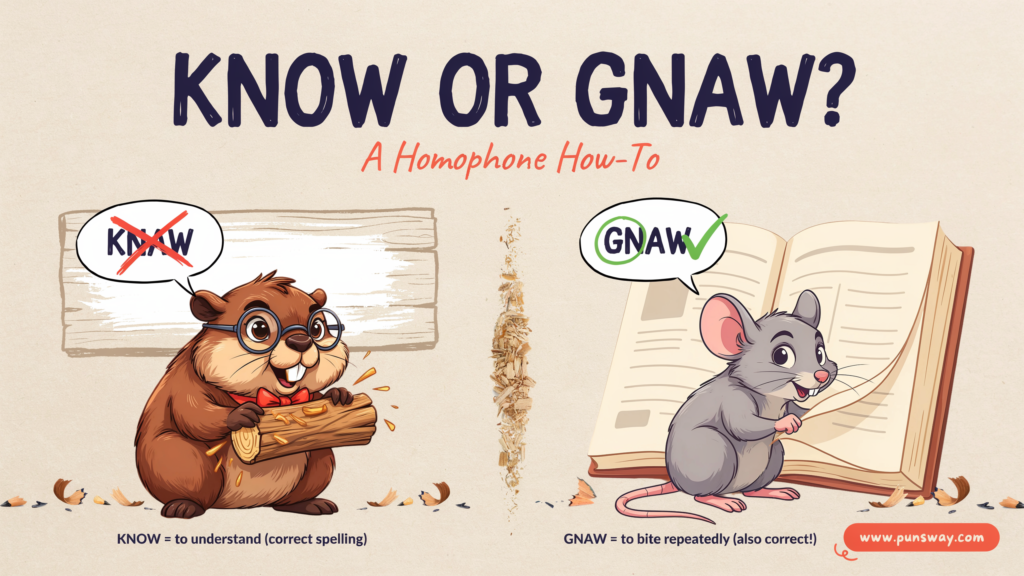
English contains many words that sound alike or have unusual spellings. Because of this, people often confuse gnaw with several other words. Learning the differences helps you avoid common spelling mistakes and improves your English vocabulary.
Gnaw vs Know
Although gnaw and know sound alike in many accents, they have completely different meanings Gnaw vs Know.
| Word | Meaning | Example |
|---|---|---|
| Gnaw | To bite repeatedly or to trouble emotionally | The dog gnawed the bone. |
| Know | To have knowledge or understanding | I know the answer. |
One word relates to chewing, while the other relates to knowledge.
Gnaw and Gnash
These words both begin with a silent G, but they describe different actions.
| Word | Meaning |
|---|---|
| Gnaw | To chew continuously |
| Gnash | To grind or clench the teeth |
Examples:
- The dog gnawed the stick.
- He gnashed his teeth in frustration.
Gnaw and Bite
A bite usually happens once.
Gnaw describes repeated chewing over a longer period.
Compare these examples:
- The dog bit the toy once.
- The dog gnawed the toy for an hour.
The second sentence clearly shows continuous action.
Gnaw and Nibble
Nibble means taking small, gentle bites.
Gnaw suggests stronger, more persistent chewing.
For example:
- The child nibbled a cookie.
- The puppy gnawed the bone.
Both involve chewing, but the intensity is different.
Gnaw and Chew
Chew is the general word.
Gnaw is a specific type of chewing that involves repeated biting, usually with the front teeth.
Think of it this way.
Every time something gnaws, it chews.
Not every act of chewing is gnawing.
Common Mistakes to Avoid
Many spelling and grammar errors involve the word gnaw. Fortunately, they are easy to avoid once you understand the basics.
Writing Knaw Instead of Gnaw
This is the most common mistake.
Incorrect:
- The dog knawed the bone.
Correct:
- The dog gnawed the bone.
Remember that knaw spelling mistake is never accepted in modern English.
Pronouncing the G
Some learners pronounce every letter.
Incorrect pronunciation:
- Guh naw
Correct pronunciation:
- Naw
The G is silent.
Using Gnaw in the Wrong Context
Gnaw works best when something happens repeatedly over time.
Incorrect:
- He gnawed the apple once.
Better:
- He took one bite of the apple.
Correct:
- The puppy gnawed the bone for hours.
Confusing Gnaw with Know
These words sound similar but have completely different meanings.
Incorrect:
- I gnaw the answer.
Correct:
- I know the answer.
How to Remember the Spelling of Gnaw
English spelling isn’t always logical, but a few simple tricks make this word easy to remember.
Memory Trick One
Picture a dog happily chewing a large bone.
Now imagine the silent G quietly watching without making a sound.
The dog does all the work.
The G stays silent.
Memory Trick Two
Remember this sentence:
“The silent G goes with chewing.”
Every time you think of chewing or biting repeatedly, think of the silent G.
Memory Trick Three
Connect gnaw with other silent G words.
- Gnat
- Gnome
- Gnash
If these words begin with a silent G, gnaw does too.
Memory Trick Four
Practice writing the word several times.
- Gnaw
- Gnaw
- Gnaw
Practice Session Knaw vs Gnaw
Choose the correct word or form to complete each sentence knaw vs gnaw.
Fill in the Blanks
- The puppy ________ the bone for nearly an hour.
- A hungry mouse can ________ through cardboard boxes.
- Worry continued to ________ at his mind during the night.
- The beaver ________ down several small trees.
(gnawed / knawed) - Rabbits sometimes ________ furniture when they are bored.
(gnaw / gnaws) - The dog is ________ on its favorite chew toy.
(gnawing / knawing) - Hunger began to ________ at the hikers after several hours.
(gnaw / gnaws) - The correct ________ of this word includes a silent G.
(spelling / pronunciation) - The rat ________ through the plastic container overnight.
(gnawed / knew) - The word “gnaw” is a ________.
(verb / noun) - The child watched the squirrel ________ on an acorn.
(gnaw / gnaws) - Fear continued to ________ away at his confidence.
(gnaw / chew) - The dog ________ off a small piece of the stick.
(gnawed / gnawing) - “Knaw” is a common ________ mistake.
(spelling / grammar) - The puppy has ________ the wooden chair leg.
(gnawed / gnawing) - Which word means “to bite repeatedly”? ________
(gnaw / know) - Rodents often ________ wood to keep their teeth healthy.
(gnaw / gnaws) - The workers found that mice had ________ through several cables.
(gnawed / gnawing) - Regret continued to ________ at her conscience.
(gnaw / gnaws) - The present participle of “gnaw” is ________.
(gnawing / gnawed) - The correct spelling is ________, not knaw.
(gnaw / gnawed) - The dog loves to ________ on bones after dinner.
(gnaw / gnaws) - Doubt slowly ________ at his confidence before the competition.
(gnawed / gnawing) - The first letter in “gnaw” is ________.
(silent / pronounced) - Learning the correct spelling helps you avoid writing ________ instead of gnaw.
(knaw / know)
Answers
| Question | Answer |
|---|---|
| 1 | gnawed |
| 2 | gnaw |
| 3 | gnaw |
| 4 | gnawed |
| 5 | gnaw |
| 6 | gnawing |
| 7 | gnaw |
| 8 | spelling |
| 9 | gnawed |
| 10 | verb |
| 11 | gnaw |
| 12 | gnaw |
| 13 | gnawed |
| 14 | spelling |
| 15 | gnawed |
| 16 | gnaw |
| 17 | gnaw |
| 18 | gnawed |
| 19 | gnaw |
| 20 | gnawing |
| 21 | gnaw |
| 22 | gnaw |
| 23 | gnawed |
| 24 | silent |
| 25 | knaw |
Here’s a trusted source for clear word meanings:
FAQs
Why do some English words have silent letters?
Silent letters are leftovers from the history of the English language. As pronunciation changed over centuries, many spellings stayed the same. Words like gnaw, knife, knight, and gnat still keep their silent letters even though they are no longer pronounced.
Are silent G words common in English?
No. Silent G words are relatively uncommon, but several are used frequently. Examples include gnaw, gnat, gnash, and gnome. Learning this small group can improve both your spelling and pronunciation.
Does “gnaw” have the same pronunciation in American and British English?
Yes. In both American English and British English, the G in gnaw is silent. The word is pronounced like “naw,” although slight accent differences may exist.
Why doesn’t English spelling always match pronunciation?
English developed from several languages, including Old English, French, Latin, and Norse. Because spelling became standardized long after pronunciation had changed, many words now contain silent letters or unexpected spellings.
Can “gnaw” be used for people as well as animals?
Yes. Literally, animals gnaw objects by chewing repeatedly. Figuratively, people experience emotions that “gnaw” at them, such as guilt, fear, stress, or hunger.
Is “gnaw” considered a formal or informal word?
Gnaw works in both formal and informal English. You’ll find it in literature, newspapers, academic writing, business articles, and everyday conversations.
What kinds of objects can animals gnaw?
Animals commonly gnaw bones, wood, rope, plastic, tree bark, nuts, furniture, and other hard materials. Rodents do this to keep their continuously growing teeth at a healthy length.
Which animals are best known for gnawing?
Beavers, mice, rats, squirrels, hamsters, rabbits, guinea pigs, and dogs are well known for gnawing. Rodents, in particular, rely on gnawing to prevent their teeth from becoming overgrown.
Is “gnaw” always used with physical objects?
No. Besides describing repeated chewing, gnaw often refers to emotions or thoughts that persist over time. For example, writers commonly say that worry, guilt, or uncertainty “gnaws at” someone’s mind.
What’s the easiest way to remember the spelling of “gnaw”?
Associate the word with other silent G words like gnat and gnome. If you remember that these words keep a silent G, it’s much easier to recall that the correct spelling is gnaw, not knaw.
Conclusion
English spelling can feel like a puzzle sometimes, and the question knaw vs gnaw is a perfect example. One tiny silent letter is all it takes to make many people stop and wonder if they’ve spelled the word correctly. The good news is that now you know the answer.
The correct spelling is always gnaw. The spelling knaw is not accepted in modern English, even though it sounds exactly the same when spoken. Whether you are talking about a dog chewing a bone, a beaver working through a tree, or worry slowly bothering someone’s mind, gnaw is the word you should use.
Donot let the silent G fool you. Think of it as the quiet team member who never says a word but still shows up to every meeting. You can’t hear it, but it definitely belongs there.
The best way to remember the spelling is to practice using the word in real sentences. Read it, write it, and say it often. Before long, spelling gnaw correctly will become second nature.
English has plenty of confusing words, but every one you learn makes you a stronger writer and a more confident speaker. So the next time someone asks, Is it knaw vs gnaw? you can smile, give the correct answer, and quietly thank that hardworking silent G for keeping English interesting.

JHON AJS is an experienced blogger and the creative voice behind Puns Way. With a sharp sense of humor and a passion for wordplay, he crafts witty puns, lighthearted jokes, and clever content that keeps readers entertained. His goal is simple make people smile while turning everyday language into laughter.