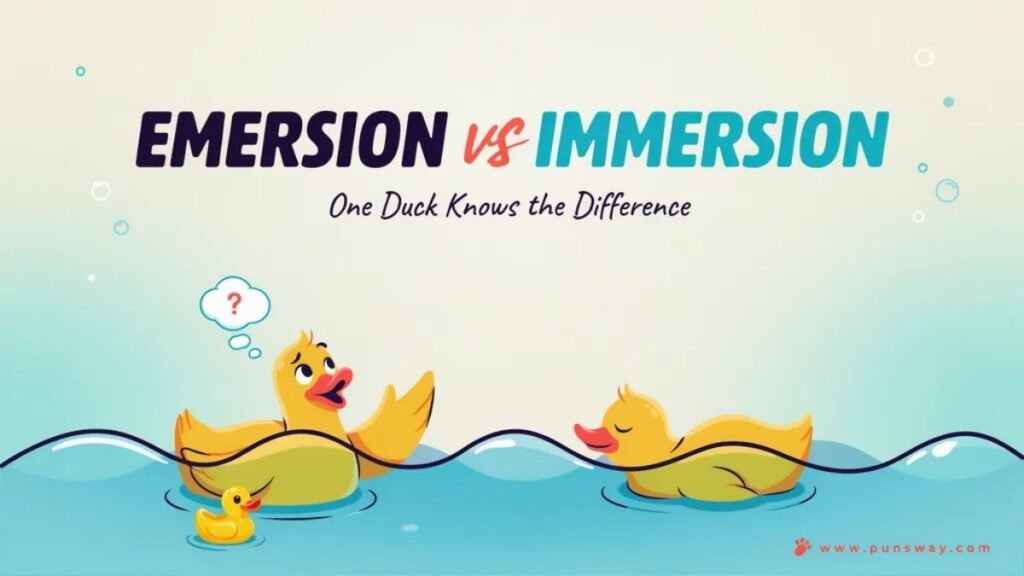
Ever stared at emersion vs immersion and thought, “Surely someone hid an extra letter just to confuse everyone?” You’re definitely not the first. These nearly identical words have tricked students, writers, scientists, and even spell-check enthusiasts for years. One means diving in, while the other means popping back out kind of like a rubber duck with dramatic timing. Mix them up, and your sentence may take an unexpected plunge. Fortunately, learning the difference is easier than teaching a fish to ride a bicycle. This guide explains each term with clear definitions, practical examples, memorable tips, and plenty of real-world context, so you’ll never second guess them again.
What Is the Difference Between Emersion vs Immersion?
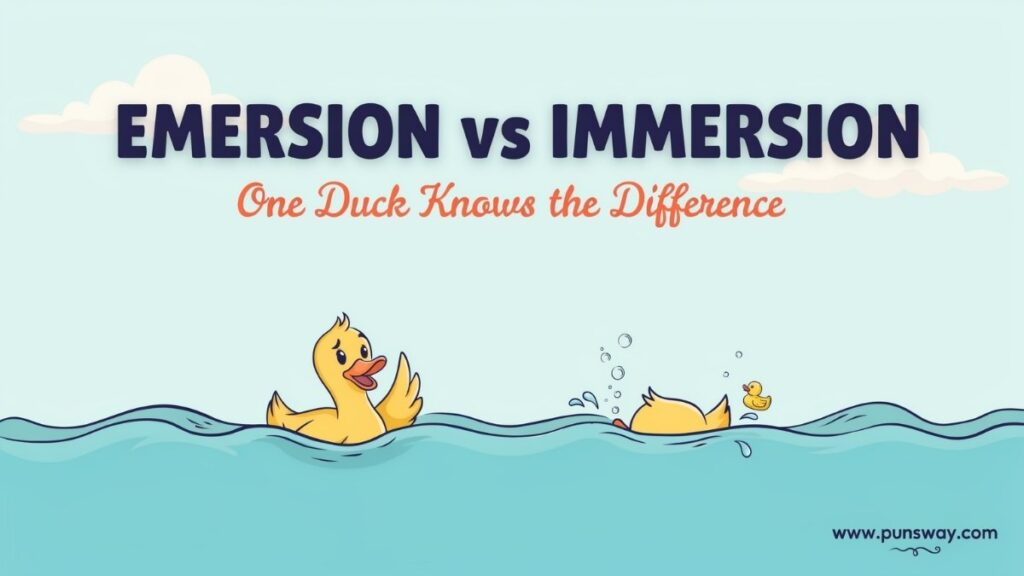
At first glance, emersion vs immersion looks like a spelling problem. In reality, its a matter of direction.
Simply put, immersion means moving into something, while emersion means moving out of it.
Imagine standing beside a swimming pool.
When a swimmer dives beneath the water surface, that’s immersion in water.
When the swimmer rises back above the surface, that’s emersion from water.
That simple visual explains the difference between emersion vs immersion better than any dictionary definition.
However, these terms extend far beyond swimming pools. Depending on the subject, they can describe physical movement, mental engagement, scientific observations, educational methods, or astronomical events.
Here’s a quick comparison.
| Feature | Immersion | Emersion |
|---|---|---|
| Basic Direction | Moving into something | Moving out of something |
| Physical Meaning | Complete submersion | Surface emergence |
| General Usage | Becoming deeply involved | Emerging from a surrounding medium |
| Everyday Frequency | Very common | Much less common |
| Common Fields | Education, psychology, gaming, biology, astronomy | Biology, botany, aquatic science, astronomy |
| Easy Memory Trick | Going in | Coming out |
A simple phrase can help you remember forever:
Immersion goes in. Emersion comes out.
Whether you’re discussing immersed vs emersed, describing an underwater environment, or explaining an astronomical event, that principle always stays the same.
Fix common more word mistakes in English
Which vs Witch vs Wich Clear Difference and funny Usage
Understanding Immersion
Among the two words, immersion is by far the more familiar. People use it daily when talking about education, travel, entertainment, psychology, technology, and personal growth.
Although the contexts vary, the underlying concept never changes.
Immersion always involves entering completely into something physically, mentally, emotionally, or socially.
You aren’t just observing from a distance. You’re actively participating.
That’s why educators encourage learning through immersion, travelers seek cultural immersion, psychologists study psychological immersion, and gamers chase an unforgettable immersion experience.
Immersion Definition
The standard immersion definition is the act of placing someone or something completely beneath a liquid or becoming deeply involved in an activity, environment, or experience.
While many people first think about physical submersion, the word has evolved well beyond water.
Today, immersion meaning commonly includes complete mental focus, emotional involvement, and continuous participation.
In other words, immersion isn’t always about getting wet. Sometimes it’s about becoming completely absorbed.
Consider these examples:
- A diver experiences immersion in water while exploring a coral reef.
- A university student joins a language immersion program to become fluent faster.
- Tourists embrace cultural immersion by living with local families instead of staying in hotels.
- A scientist performs experiments requiring complete physical submersion of laboratory equipment.
- Readers often lose themselves in an unforgettable novel, creating a truly immersive experience.
Although each example belongs to a different field, every one reflects the same core idea entering fully into an environment or activity.
What Does Immersion Mean?
If someone asks, “What does immersion mean?”, here’s the simplest explanation:
Immersion means becoming completely surrounded, fully engaged, or entirely involved in something.
That “something” could be water, education, language, psychology, science, culture, or technology.
The meaning expands naturally depending on the context.
| Discipline | Immersion Meaning |
|---|---|
| Education | Learning through direct participation instead of passive study |
| Language Learning | Developing fluency by constant exposure to the language |
| Psychology | Deep mental engagement with an activity or experience |
| Biology | Physical submersion beneath water or another liquid |
| Astronomy | A celestial object disappearing behind another during an occultation |
| Gaming | Feeling completely absorbed inside a virtual world |
| Everyday English | Giving something your full attention |
Because the concept applies to so many subjects, immersion terminology appears across academic journals, classrooms, laboratories, research papers, and everyday conversations.
Common Uses of Immersion
One reason immersion remains such a powerful word is its flexibility. It fits naturally into education, science, psychology, travel, entertainment, and professional training without losing its original meaning.
Let’s explore the most common applications.
Immersion in Learning
The immersion learning method places students inside the learning process rather than asking them to simply memorize information.
Instead of translating vocabulary lists, students hear, speak, read, and write in the target language every day.
Examples include:
- Language immersion schools
- Study-abroad programs
- Clinical medical training
- Hands-on engineering laboratories
- Interactive science workshops
These approaches encourage:
- Active participation
- Experiential learning
- Reflective learning
- Observational learning
- Long-term knowledge retention
Research consistently shows that learners often remember concepts longer when they actively experience them rather than passively reading about them.
Cultural Immersion
What is cultural immersion?
Cultural immersion means living within another culture and participating in everyday life instead of observing from the sidelines.
Rather than visiting famous landmarks alone, you experience local traditions firsthand.
Someone practicing cultural immersion might:
- Live with a host family.
- Shop at neighborhood markets.
- Attend community celebrations.
- Learn local customs.
- Speak the native language daily.
- Prepare traditional meals alongside local residents.
These experiences encourage cultural adaptation, broaden perspectives, and create lasting memories that no guidebook can fully capture.
Psychological Immersion
What is psychological immersion?
In psychology, psychological immersion refers to becoming so mentally engaged that outside distractions temporarily disappear.
Many people experience this state without realizing it.
For example:
- An artist spends hours painting without noticing the time.
- A musician becomes completely absorbed during a live performance.
- A reader forgets the outside world while finishing an exciting novel.
- A gamer feels emotionally connected to a richly designed virtual world.
Researchers studying immersion in psychology often associate this deep focus with improved concentration, stronger emotional involvement, increased motivation, and enhanced learning.
Immersion in Science
The phrase immersion in science appears across multiple scientific disciplines.
Scientists commonly use the term when discussing:
- Laboratory experiments
- Marine biology
- Environmental monitoring
- Oceanographic research
- Engineering tests
- Chemical analysis
Whether researchers study a submerged object, investigate an underwater environment, or analyze aquatic ecosystems, the idea remains the same: something becomes completely surrounded by another medium.
Immersion in Astronomy
Astronomy gives immersion a highly specialized definition.
During a celestial occultation, immersion marks the precise moment when one celestial object disappears behind another from the observer’s viewpoint.
For example, the Moon may gradually hide a distant star. The instant the star vanishes is called immersion.
Later, when the star becomes visible again, astronomers call that event emersion.
Because these moments help scientists measure orbital motion and celestial positions with remarkable accuracy, immersion in astronomy remains an important technical term in observational science.
Fix common more word mistakes in English
Dysregulated vs Disregulated One Is Correct and Touch of Humor
Key Characteristics of Immersion
No matter the discipline, nearly every form of immersion shares the same essential characteristics.
- Complete submersion physically or mentally.
- Deep focus with minimal distractions.
- Continuous interaction with the surrounding environment.
- Total engagement rather than passive observation.
- Active learning through direct participation.
- Strong emotional or intellectual involvement.
- Rich, memorable experiences that improve understanding.
Whether you’re discussing immersion in education, immersion in psychology, immersion in science, or simply immersion in water, the central idea never changes.
Understanding Emersion
Although immersion dominates everyday conversations, emersion is equally important in scientific and technical writing. The word may appear less frequently, yet it carries a precise meaning that shouldn’t be overlooked.
Simply put, if immersion means moving into something, emersion means moving out of it.
That simple distinction explains nearly every use of emersion vs immersion across biology, botany, marine science, environmental studies, and astronomy. Once you understand this relationship, choosing the correct word becomes much easier.
Unlike immersion, which often describes deep engagement or participation, emersion almost always refers to a physical action. Something rises above a surface, leaves a surrounding medium, or becomes visible after being hidden.
Whether you’re studying aquatic ecosystems or observing a celestial event, emersion meaning always centers on emergence.
Learn the difference between confusing more English words
224+ Bro Jokes and Puns Brilliant Wordplay for Pun Lovers
Emersion Definition
The official emersion definition is the act of emerging from a liquid or another surrounding medium. In astronomy, it also describes the exact moment a hidden celestial object becomes visible again after an occultation.
In simple language, emersion meaning can be summarized in three words:
Coming back out.
That straightforward explanation works surprisingly well in nearly every situation.
Imagine these everyday scenes:
- A scuba diver finishes an underwater expedition and returns to the surface.
- A submarine slowly rises until its hull breaks through the waves.
- Marsh plants extend their stems above shallow water.
- The Moon uncovers a distant star during an astronomical observation.
Every example demonstrates surface emergence, emerging from liquid, or becoming visible again after temporary concealment.
What Does Emersion Mean?
Many learners ask, “What does emersion mean?” because they encounter the word far less often than immersion.
The easiest definition is this:
Emersion means emerging from a surrounding medium or becoming visible again after being hidden.
Unlike immersion meaning, which often includes emotional involvement or learning, emersion almost always refers to an observable physical event.
The exact application changes from one discipline to another, but the underlying concept remains remarkably consistent.
| Discipline | Emersion Meaning |
|---|---|
| Biology | Organisms or body parts emerging above the water surface |
| Botany | Plant structures growing above water while roots remain submerged |
| Astronomy | A celestial object reappearing after an occultation |
| Marine Science | Returning from an underwater environment |
| Environmental Science | Emergence above a surrounding liquid or habitat |
This consistency makes emersion terminology surprisingly easy to understand once you recognize the direction of movement.
Learn the difference between confusing more English words
Physics Fundamentals Guide and Touch of Humor
Common Uses of Emersion
Although emersion appears less frequently in everyday English, it plays an essential role across multiple scientific disciplines.
Each field applies the word slightly differently, yet every definition shares one important idea:
Something emerges.
Let’s explore the most common applications.
Emersion in Biology
In biology, emersion describes organisms leaving the water or exposing body parts above the surface.
Many aquatic animals repeat this emersion process countless times every day.
Examples include:
- A dolphin surfacing to breathe.
- A crocodile lifting its eyes above the waterline.
- A sea turtle emerging before taking another breath.
- A frog climbing onto a floating log.
- A seal resting on coastal rocks after swimming.
These actions illustrate emersion from water, where an organism transitions from a fully submerged state to one that is partially or completely above the surface.
Scientists frequently use the term while studying animal behavior, respiration, and habitat adaptation.
Emersion in Botany
Botany provides one of the clearest examples of emersion terminology.
Understanding immersed vs emersed plants is fundamental when studying ponds, marshes, wetlands, rivers, and other aquatic ecosystems.
Although both plant types grow in water, they develop very differently.
Immersed Plants
Immersed plants remain completely beneath the water surface throughout most or all of their life cycle.
Common examples include:
- Hornwort
- Hydrilla
- Eelgrass
- Elodea
These submerged plants absorb nutrients directly from the surrounding water and thrive in a fully underwater environment.
Emersed Plants
By contrast, emersed plants keep their roots anchored beneath the water while allowing stems, flowers, or leaves to extend above the surface.
Examples include:
- Cattails
- Bulrushes
- Reeds
- Rice
- Papyrus
- Lotus
Learning the botanical meaning of emersed helps students understand why many aquatic plants flourish in shallow wetlands rather than deep lakes.
This distinction also explains why immersed plants and emersed plants support different wildlife, oxygen levels, and ecological functions.
Emersion in Astronomy
Astronomy gives emersion one of its most precise technical definitions.
During a celestial occultation, one celestial object temporarily blocks another from an observer’s view.
The sequence unfolds like this:
Visible Object
      ↓
Immersion
      ↓
Hidden Behind Another Celestial Body
      ↓
Emersion
      ↓
Visible Again
The moment the hidden object becomes visible again is called emersion in astronomy.
Astronomers record these observations with exceptional accuracy because they help determine:
- Orbital paths
- Eclipse timing
- Planetary motion
- Celestial distances
- Surface characteristics of moons and asteroids
For this reason, immersion and emersion in eclipses remain important concepts in observational astronomy.
Learn the difference between confusing more English words
Cryer vs Crier Difference and Uses
Emersion vs Immersion Side by Side Comparison
Now that you’ve explored both definitions, comparing emersion vs immersion becomes much simpler.
Although the words differ by only one letter, they describe opposite stages of the same process.
| Feature | Immersion | Emersion |
|---|---|---|
| Core Meaning | Entering a medium | Leaving a medium |
| Direction | Inward or downward | Outward or upward |
| Physical Action | Complete submersion | Surface emergence |
| General Concept | Becoming surrounded | Becoming exposed again |
| Everyday Usage | Very common | Relatively uncommon |
| Education | Widely used | Rarely used |
| Psychology | Deep engagement | Rarely applicable |
| Biology | Organism becomes submerged | Organism emerges above water |
| Botany | Immersed plants | Emersed plants |
| Astronomy | Object disappears | Object reappears |
The easiest memory trick still works perfectly:
Immersion goes in Emersion comes out.
Immersion and Emersion Across Different Fields
One reason people confuse these terms is that they appear in many disciplines.
Fortunately, the direction of movement never changes.
| Field | Immersion | Emersion |
|---|---|---|
| Education | Learning through direct participation | Rarely used |
| Language Learning | Continuous language exposure | Not applicable |
| Psychology | Complete mental engagement | Limited usage |
| Biology | Physical submersion | Emerging above water |
| Botany | Fully submerged vegetation | Vegetation extending above the surface |
| Marine Science | Descending beneath water | Returning above water |
| Astronomy | Celestial object disappears | Celestial object reappears |
This comparison highlights why immersion compared with emersion involves far more than spelling. Each term represents a distinct phase within the same natural process.
Learn the difference between confusing more English words
Flatform vs Platform Confusion
Immersed vs Emersed
Another common source of confusion involves immersed vs emersed.
Although the spellings differ by only one letter, their meanings are exact opposites.
| Term | Meaning |
|---|---|
| Immersed meaning | Completely surrounded by water or another medium |
| Emersed meaning | Rising above the surrounding water while remaining rooted or partially submerged |
Consider these examples:
- A fish remains immersed because its body stays underwater.
- A lotus leaf is emersed because it extends above the water surface.
- A diver experiences immersion in water before emersion from water during the ascent.
- During an eclipse, a distant star undergoes immersion during eclipse when it disappears and emersion during eclipse when it becomes visible again.
Once you visualize movement, choosing between immersed and emersed becomes almost effortless.
Key Points to Remember
Before moving on, keep these simple ideas in mind:
- Immersion means entering, surrounding, or becoming fully involved.
- Emersion means emerging, rising, or becoming visible again.
- Immersion definition and examples appear regularly in education, psychology, language learning, gaming, and science.
- Emersion definition and examples occur primarily in biology, botany, marine science, and astronomy.
- The opposite of immersion is emersion.
- The opposite of immersed is emersed.
- Picture a swimmer diving beneath the surface and then rising back into the air. That simple mental image perfectly illustrates the difference between emersion vs immersion every single time.
Learn the difference between similar English words
Scoup vs Scoop Spelling Mistake That Confuses Everyone
When Should You Use Each Word?
Knowing the definitions is only half the battle. The real challenge is choosing the correct word while writing or speaking.
Many people understand the basic idea behind emersion vs immersion, yet they still hesitate when its time to use one in a sentence. That’s perfectly normal. Since immersion appears far more often than emersion, its easy to assume they’re interchangeable. They aren’t.
The simplest way to remember the difference between emersion vs immersion is to focus on the direction of movement.
- Immersion means moving into something.
- Emersion means moving out of something.
Once you recognize that pattern, selecting the right word becomes almost automatic.
Use Immersion When
Choose immersion whenever something becomes completely surrounded, deeply involved, or fully engaged in a physical environment, learning process, culture, or experience.
In nearly every context, the movement is inward.
Use Immersion for Physical Submersion
The most literal meaning of immersion involves placing something beneath a liquid.
Examples include:
- A diver begins immersion in water before exploring a coral reef.
- Scientists tested the equipment after complete physical submersion.
- The rescue team located the submerged object several hours later.
- The experiment required the sample to remain fully submerged for twenty four hours.
- Marine researchers measured water pressure during complete immersion.
Every example describes entering a liquid rather than leaving it.
Use Immersion in Education
One of the most common modern uses involves education.
The immersion learning method encourages students to learn through constant participation instead of passive memorization.
Examples include:
- Students improved quickly through language immersion.
- Medical students practiced skills in realistic clinical environments.
- Young children learned naturally through daily interaction.
- Teachers encouraged active participation instead of lengthy lectures.
- Classroom projects promoted experiential learning and teamwork.
Because learners experience concepts directly, retention often improves significantly.
Use Immersion for Language Learning
Perhaps the best-known educational example is language immersion.
Rather than translating every sentence, learners communicate almost entirely in the target language.
For example:
- Living in Spain provides complete Spanish language immersion.
- Exchange students gain confidence through everyday conversations.
- Watching local television accelerates listening skills.
- Shopping at neighborhood markets strengthens vocabulary naturally.
This continuous exposure transforms learning into an everyday experience instead of a classroom exercise.
Fix common more word mistakes in English
Waring vs Wearing Differences and Examples With Funny Twist
Use Immersion in Psychology
Another important application appears in psychology.
Immersion in psychology describes becoming deeply absorbed in an activity until outside distractions fade into the background.
For example:
- A musician becomes completely immersed during a concert.
- An athlete enters a state of intense concentration.
- Readers often forget the passing of time while enjoying a captivating novel.
- Artists lose themselves in creative work for hours.
- Virtual reality creates remarkable psychological immersion.
This level of focus often increases creativity, motivation, and enjoyment.
Use Immersion When Discussing Culture
If you’re talking about adapting to another society, cultural immersion is the correct expression.
Examples include:
- Living with a host family encouraged meaningful cultural immersion.
- Volunteers learned local customs through everyday interactions.
- Travelers developed deeper cultural understanding than ordinary tourists.
- Community festivals provided authentic experiences.
- Local friendships accelerated cultural adaptation.
Unlike sightseeing, cultural immersion emphasizes participation rather than observation.
Use Immersion in Science
Scientists regularly use immersion when discussing materials, organisms, laboratory procedures, and aquatic research.
Examples include:
- Researchers monitored fish during prolonged immersion in water.
- Marine biologists studied life within an underwater environment.
- Engineers tested waterproof sensors after complete immersion.
- Environmental scientists analyzed conditions affecting aquatic ecosystems.
- Divers documented coral reefs beneath the surface.
Whether studying biology or engineering, the underlying concept remains identical.
Use Immersion in Astronomy
Astronomy uses immersion in a highly specialized way.
During an occultation, immersion marks the precise instant a celestial body disappears behind another object.
For example:
- The distant star reached immersion during eclipse at exactly 9:14 p.m.
- Astronomers recorded the disappearance with high-speed cameras.
- Observers measured the event to refine orbital calculations.
Later, the reverse event becomes emersion during eclipse.
Use Emersion When
Use emersion whenever something rises, emerges, or becomes visible after previously being submerged or hidden.
Instead of entering an environment, the subject leaves it.
That outward movement defines every correct use of emersion terminology.
Use Emersion for Emerging From Water
This is the most straightforward application.
Examples include:
- The diver completed emersion from water after a thirty minute dive.
- Dolphins surface repeatedly throughout the day.
- The submarine began its slow ascent.
- A swimmer reached the surface safely.
- Sea turtles emerge regularly to breathe.
Each situation illustrates movement toward the surface.
Use Emersion in Biology
Biologists commonly use emersion when studying aquatic organisms.
Examples include:
- Amphibians experience repeated emersion process throughout their life cycle.
- Marine mammals surface for oxygen.
- Certain insects emerge after developing underwater.
- Scientists observed fish behavior immediately after emersion.
- Wetland animals depend on both aquatic and terrestrial habitats.
In biology, emersion often marks an important behavioral transition.
Use Emersion in Botany
Botany offers another excellent example.
Many aquatic plants spend part of their lives beneath water while extending leaves or flowers into the air.
Examples include:
- Lotus plants produce emersed plants with floating leaves.
- Cattails develop tall stems above shallow wetlands.
- Reeds remain rooted underwater while growing upward.
- Rice thrives with submerged roots and exposed stems.
- Marsh vegetation demonstrates classic emersion examples.
Understanding the botanical meaning of emersed makes plant identification much easier.
Use Emersion in Astronomy
Astronomers use emersion to describe the exact moment a hidden celestial object becomes visible again.
Examples include:
- The Moon’s shadow passed, allowing stellar emersion.
- Scientists measured the precise time of reappearance.
- The observatory recorded the complete astronomical event.
- The telescope captured the object’s return.
- Researchers compared immersion and emersion timings to improve orbital models.
Without emersion in astronomy, many eclipse calculations would be incomplete.
Learn the difference between similar English words
Provider vs Providor, Which Spelling Is Correct?
A Simple Decision Guide
Still unsure which word to choose?
Ask yourself one simple question:
Is something going in, or is it coming out?
If the answer is going in, use immersion.
If the answer is coming out, use emersion.
That single question resolves most writing mistakes instantly.
Quick Memory Tricks
Small memory aids often work better than lengthy grammar rules.
Remember these associations:
| Word | Memory Trick |
|---|---|
| Immersion | In begins with I. Think Into. |
| Emersion | E reminds you of Exit or Emerge. |
| Immersed | Completely surrounded. |
| Emersed | Above the surface. |
Another easy visualization helps even more.
Imagine a swimmer.
- The dive is immersion.
- The return to the surface is emersion.
That simple picture captures the entire concept behind immersion versus emersion.
Common Writing Rule
Whenever you encounter emersion vs immersion, avoid choosing based on which word sounds more familiar.
Instead, think about the action taking place.
If something experiences total engagement, complete submersion, or enters a new environment, immersion is correct.
If something emerges from water, rises above the surface, or becomes visible again, emersion is the right choice.
Following this simple rule will help you use both terms confidently in science, education, psychology, biology, astronomy, and everyday writing.
Looking for more
Moment vs Momment Which One Is Correct?
Real-Life Examples: Why Choosing the Correct Word Matters
Understanding emersion vs immersion isn’t just about passing an English test or memorizing dictionary definitions. Using the correct word improves clarity, prevents misunderstandings, and demonstrates subject knowledge.
The distinction becomes especially important in education, science, psychology, biology, botany, and astronomy, where one incorrect word can completely change the intended meaning.
Let’s explore how immersion and emersion appear in real-world situations.
Everyday English Examples
Outside academic writing, immersion is far more common than emersion. People naturally use it to describe becoming deeply involved in an activity, hobby, or experience.
Consider these examples:
| Correct Sentence | Why It Works |
|---|---|
| She enjoyed complete cultural immersion while living in Japan. | She became fully involved in another culture. |
| The museum offers an immersive experience using virtual reality. | Visitors feel surrounded by the experience. |
| Reading historical novels creates total psychological immersion. | The reader becomes mentally absorbed. |
| Children learn quickly through language immersion programs. | Students are surrounded by the language daily. |
| The documentary creates a remarkable sense of immersion. | Viewers feel deeply engaged. |
Using emersion in any of these sentences would be incorrect because nothing is emerging or leaving a surrounding environment.
Education Learning Through Immersion
One of the most successful teaching approaches is immersion in learning.
Instead of relying solely on textbooks, students learn by actively participating in realistic situations.
Case Study Language Immersion
Imagine two students learning Spanish.
Student A memorizes vocabulary for thirty minutes each day.
Student B joins a language immersion program, speaks Spanish in class, watches Spanish television, orders meals in Spanish, and practices daily conversations with native speakers.
After several months, Student B usually develops stronger speaking confidence, better listening comprehension, and a more natural accent because learning occurs through continuous exposure rather than isolated study.
This example illustrates why learning through immersion often produces deeper understanding than passive memorization.
Other Educational Examples
Immersion is equally valuable in many learning environments:
- Medical students train in simulated hospitals before treating real patients.
- Engineering students build functioning prototypes instead of only reading manuals.
- Culinary students prepare meals in professional kitchens.
- Music students perform before live audiences.
- Science students conduct laboratory experiments rather than only studying diagrams.
These experiences combine active participation, experiential learning, and reflective learning, creating lasting knowledge.
Psychology Total Mental Engagement
In psychology, psychological immersion describes a state of deep mental focus.
When people become fully engaged in meaningful activities, they often lose awareness of time and external distractions.
Examples include:
- A writer spends hours working without noticing the clock.
- An artist becomes completely absorbed in a painting.
- A chess player concentrates so deeply that surrounding conversations disappear.
- A gamer experiences a realistic virtual world that feels remarkably authentic.
- A musician becomes entirely focused during a live performance.
These examples demonstrate that immersion in psychology doesn’t involve water at all. Instead, it reflects complete cognitive and emotional involvement.
Biology Immersion and Emersion in Nature
Biology provides some of the clearest examples of immersion and emersion.
Aquatic organisms constantly transition between these two states.
Example: Sea Turtles
A sea turtle spends much of its life underwater.
- While swimming beneath the surface, the turtle experiences immersion in water.
- When it rises to breathe, it undergoes emersion from water.
Both actions occur repeatedly throughout the day.
Example: Frogs
Frogs move effortlessly between aquatic and terrestrial environments.
They begin with physical submersion, then climb onto rocks, logs, or floating vegetation during surface emergence.
This natural cycle perfectly illustrates immersion and emersion differences.
Botany Immersed vs Emersed Plants Explained
Botany offers another excellent illustration of the difference between emersion vs immersion.
Understanding immersed vs emersed plants helps students identify vegetation in wetlands, ponds, rivers, and lakes.
Immersed Plants
These plants remain completely below the water surface.
Examples include:
- Hydrilla
- Hornwort
- Eelgrass
- Elodea
Because they live in an underwater environment, every part of the plant remains submerged.
Emersed Plants
These plants grow with underwater roots while extending stems, flowers, or leaves above the surface.
Common examples include:
- Cattails
- Reeds
- Bulrushes
- Papyrus
- Rice
Knowing the botanical meaning of emersed is especially useful for biology students, gardeners, environmental scientists, and wetland researchers.
Astronomy: Watching an Eclipse
Astronomy uses these terms with exceptional precision.
Imagine observing a lunar occultation through a telescope.
A distant star slowly approaches the edge of the Moon.
First, the star disappears.
That moment is called immersion during eclipse.
Several minutes later, the star becomes visible again.
That moment is emersion during eclipse.
Professional astronomers record both events because they help calculate:
- Planetary motion
- Orbital paths
- Celestial distances
- Eclipse timing
- Surface irregularities on celestial bodies
Without these precise observations, many astronomical calculations would be far less accurate.
Workplace Communication
Although emersion rarely appears in everyday business writing, immersion is common across many industries.
For example:
- New employees complete an onboarding immersion experience.
- Leadership programs encourage complete workplace immersion.
- Technology companies develop immersive virtual reality training.
- Museums create immersive exhibitions for visitors.
- Businesses use immersive simulations for employee development.
Choosing emersion in these situations would sound incorrect because participants are entering an experience rather than leaving one.
Science and Environmental Research
Scientists frequently use immersion terminology and emersion terminology when describing field observations.
For example:
| Situation | Correct Term |
|---|---|
| Laboratory equipment placed underwater | Immersion |
| A diver returning to the surface | Emersion |
| Fish swimming below the water | Immersion |
| A seal surfacing to breathe | Emersion |
| Water-resistant product testing | Immersion |
| Marsh plants extending above shallow water | Emersion |
This simple distinction keeps scientific writing accurate and consistent.
Learn the difference between similar English words
Focussing or Focusing Which Spelling Is Correct?
Correct vs Incorrect Usage
The easiest way to master immersion compared with emersion is to compare correct and incorrect sentences.
| Incorrect | Correct |
|---|---|
| The student completed emersion in French class. | The student completed language immersion in French class. |
| The diver began emersion before entering the ocean. | The diver began immersion in water before exploring the reef. |
| The lotus remained immersed above the water. | The lotus remained emersed above the water. |
| The Moon reached emersion when the star disappeared. | The Moon reached immersion when the star disappeared. |
| The star entered immersion after becoming visible again. | The star entered emersion after becoming visible again. |
Notice that every correction follows the same principle:
- Entering = Immersion
- Leaving = Emersion
Key Lesson
Whether you’re discussing cultural immersion, language immersion, psychological immersion, immersion in science, emersion in astronomy, or emersed plants, one question always leads you to the correct answer:
Is the subject moving into something or coming out of it?
If it moves inward, choose immersion.
If it emerges outward, choose emersion.
That simple rule applies across education, biology, psychology, environmental science, astronomy, and everyday communication. Once you start thinking in terms of direction rather than spelling, the confusion between emersion vs immersion quickly disappears.
Here’s a trusted source for clear word meanings:
Practice Session emersion vs immersion
Test your understanding of emersion vs immersion by filling in the blanks with the correct word or phrase.
- The scuba diver began __________ as soon as he entered the ocean.
- After forty minutes underwater, the diver completed __________ safely.
- A __________ program helps students learn by using the target language every day.
- The opposite of immersion is __________.
- Lotus leaves are __________ because they rise above the water surface.
- Hydrilla is an example of an __________ plant.
- During a lunar occultation, a star disappears at __________.
- When the hidden star becomes visible again, the event is called __________.
- Complete __________ in water allows marine researchers to observe coral reefs closely.
- A seal must undergo __________ regularly to breathe fresh air.
- __________ means becoming deeply involved in an activity or experience.
- __________ means emerging from water or another surrounding medium.
- The students improved quickly through __________ immersion.
- Wetland reeds are examples of __________ plants.
- A fish remains __________ while swimming beneath the water.
- The astronaut watched the celestial object’s __________ after the eclipse.
- Cultural __________ helps travelers understand local traditions more deeply.
- The submarine began its slow __________ toward the surface.
- Scientists tested the equipment after complete __________ in saltwater.
- The swimmer reached the surface after a successful __________.
- In psychology, __________ describes deep mental engagement.
- A diver is fully __________ while exploring underwater caves.
- The teacher encouraged __________ learning instead of memorization.
- During an occultation, the planet reached __________ before disappearing behind the Moon.
- Remember the rule: Immersion goes in, __________ comes out.
Answers
- immersion
- emersion
- language
- emersion
- emersed
- immersed
- immersion
- emersion
- immersion
- emersion
- Immersion
- Emersion
- language
- emersed
- immersed
- emersion
- immersion
- emersion
- immersion
- emersion
- immersion
- immersed
- immersion
- immersion
- emersion
FAQs
What does emersion mean?
Emersion is the act of emerging from a liquid or another surrounding medium. In astronomy, it also refers to the moment a celestial object becomes visible again after being hidden during an occultation.
Is emersion a real word?
Yes. Emersion is a valid English word commonly used in biology, botany, marine science, and astronomy. Although it is less common than immersion, it has a precise scientific meaning.
What is the difference between immersion and emersion?
The key difference is direction. Immersion means entering or becoming surrounded by a liquid, environment, or experience, while emersion means emerging from a liquid or becoming visible again after being hidden.
What is the meaning of immersion?
Immersion means complete involvement or submersion. It can describe being fully underwater or becoming deeply engaged in activities such as language learning, education, psychology, or cultural experiences.
What does emersed mean?
Emersed describes something that rises above the water surface while remaining rooted or partially submerged. The term is commonly used to describe aquatic plants.
What is the difference between immerse and emerse?
Immerse means to put something into a liquid or become deeply involved in an activity. Emerse means to rise out of a liquid or emerge above the surface.
How do you spell emersion?
The correct spelling is emersion: E-M-E-R-S-I-O-N. It is often confused with immersion, but the two words have different meanings.
What is the meaning of the word emersion?
The word emersion refers to the process of emerging from water or another surrounding medium. In astronomy, it describes the reappearance of a celestial object after an occultation.
What is an example of immersion?
A student participating in a language immersion program is surrounded by the target language throughout the day. Another example is a diver entering the water for a scuba dive.
What is the opposite of immersion?
The opposite of immersion is emersion. Immersion means moving into a medium, while emersion means coming out of it.
Is immersed fully submerged?
Usually, yes. Immersed means completely surrounded by a liquid or another medium. However, in some contexts, it can also describe being deeply engaged in an activity rather than physically underwater.
Is it submersion or immersion?
Both words are correct but have different uses. Submersion specifically refers to being completely underwater, while immersion can mean either physical submersion or deep involvement in an activity or experience.
What is the difference between submerged and immersed?
Submerged emphasizes being entirely below the water’s surface. Immersed can also mean fully underwater, but it additionally describes deep mental, educational, or emotional engagement.
Is immerse the same as submerge?
Not exactly. Immerse can refer to placing something in water or becoming deeply involved in an activity. Submerge focuses only on putting something beneath the surface of a liquid.
Does submerged mean fully underwater?
Yes. Submerged generally means completely beneath the surface of a liquid, especially water.
What can I say instead of immersion?
Depending on the context, alternatives include engagement, involvement, absorption, participation, submersion, deep focus, or total engagement.
What is a synonym for immersion?
Common synonyms include submersion, absorption, engagement, involvement, participation, and deep concentration, depending on the context.
What’s a synonym for immerse?
Synonyms for immerse include submerge, dip, plunge, engage, absorb, and involve.
What is the difference between submerse and emerse?
Submerse means to place something below the surface of a liquid. Emerse means to rise above or emerge from the liquid.
Is it immersion or emmersion?
The correct spellings are immersion and emersion. Emmersion is a common misspelling and is not the standard English form.
What is immersion and emersion?
Immersion is the act of entering or becoming fully surrounded by a medium or experience. Emersion is the oppositeit describes emerging from that medium or becoming visible again.
What is a better word for immersive?
Depending on the context, alternatives include engaging, interactive, captivating, absorbing, lifelike, realistic, or allencompassing.
What is the correct spelling of immersion?
The correct spelling is immersion: I-M-M-E-R-S-I-O-N.
Is immersion a feeling?
Not exactly. Immersion is a state of complete involvement or engagement. While it can create strong feelings of focus or presence, it is not considered an emotion itself.
How do you use the word immersion in a sentence?
Example: The university offers a language immersion program that helps students become fluent through daily conversation and cultural experiences
What are the types of immersion?
Common types include language immersion, cultural immersion, psychological immersion, and physical immersion in water or another liquid.
Learn how to use confusing more words correctly
Ingage vs Engage Difference and usage
CONCLUSION
Congratulations you are officially surfaced from the deep waters of emersion vs immersion without needing a life jacket! What once looked like two mischievous twins should now be easy to tell apart. Just remember the golden rule: immersion dives in, while emersion climbs out. Whether you’re writing about language immersion, cultural immersion, aquatic plants, psychology, or an astronomical event, you know exactly which word deserves the spotlight. The next time someone mixes them up, resist the urge to dramatically gasp. Instead, smile, share your newfound knowledge, and help them stay afloat. After all, confusing these two words should be underwater not in your writing!

JHON AJS is an experienced blogger and the creative voice behind Puns Way. With a sharp sense of humor and a passion for wordplay, he crafts witty puns, lighthearted jokes, and clever content that keeps readers entertained. His goal is simple make people smile while turning everyday language into laughter.