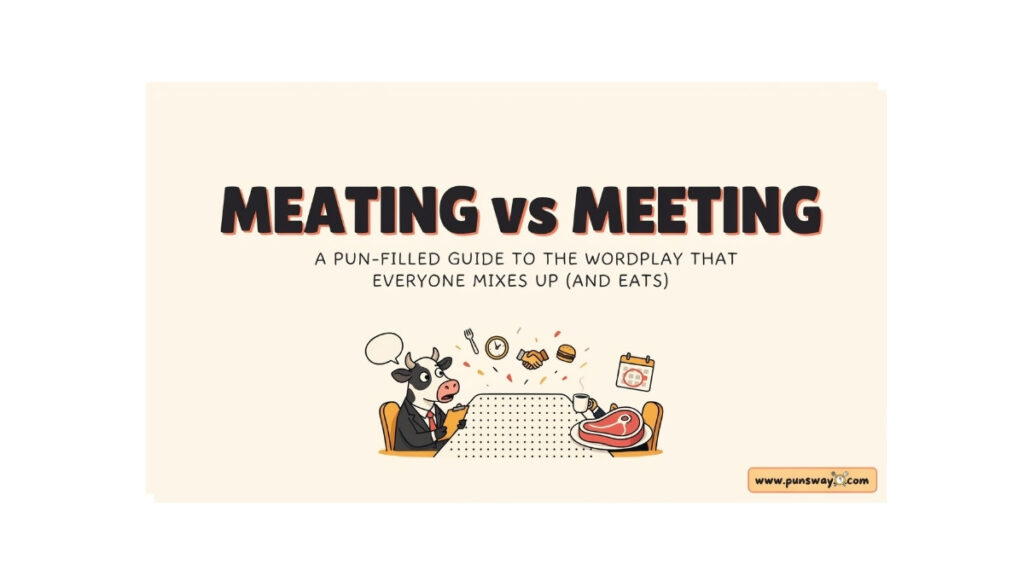
Have you ever sent an email announcing a meating vs meeting and wondered why nobody replied until someone asked if lunch was included? Dont worry you are joined a surprisingly large club. This tiny one letter mix up creates one of the most common spelling mistakes in English, yet its also one of the easiest to fix. Understanding the difference between meating vs meeting helps you write with confidence, sound more professional, and avoid awkward misunderstandings in emails, reports, and everyday conversations. This guide clearly explains each word, its meaning, grammar, correct usage, and memorable examples so you can choose the right spelling every single time.
Meating vs Meeting: What’s the Real Difference?
At first glance, meating vs meeting differ by only one letter. In practice, however, they belong in completely different categories of English vocabulary.
The confusion usually begins with fast typing. Since the words meet and meat look similar, many people accidentally replace one with the other. This creates a classic meating typo, even though the writer intended to use meeting.
Here’s the short answer.
| Word | Correct? | Meaning | Everyday Usage |
|---|---|---|---|
| Meeting | ✅ Yes | A gathering of people or the act of coming together | Extremely common |
| Meating | ⚠ Rare | Related to meat in specialized or historical contexts | Almost never used in everyday English |
Understand confusing English more words simply
Moment vs Momment Which One Is Correct?
If your sentence refers to people gathering, attending an event, holding a discussion, or participating in an online meeting, the correct word is meeting.
For example:
- We have a scheduled meeting at 9:00 AM.
- The business meeting lasted two hours.
- She joined the online meeting from home.
- Our team will meet up after lunch.
- They plan to meet someone from the marketing department.
Every sentence above uses the meeting noun correctly.
Now compare those examples with these incorrect versions.
1. ❌ We have a scheduled meating tomorrow.
2.❌ The client canceled today’s meating.
3❌ Please join the Zoom meating.
Although many people type these sentences every day, each contains a meating mistake. This isn’t a grammar problem. It’s primarily a spelling error meating caused by confusing meet with meat.
Is Meating a Word?
One of the most common questions people ask is, “Is meating a word?”
The answer requires a little context.
In standard modern English, meeting is the accepted and dictionary-approved word when referring to a gathering, discussion, conference, or appointment. If you’re writing about work, school, clubs, interviews, conferences, or video calls, meeting is the correct spelling every time.
The word meating does exist in very limited historical or specialized contexts connected to preparing or supplying animal flesh. In other words, it relates to meat meaning rather than people gathering together. Because this usage is rare, most native English speakers never encounter it during everyday reading or conversation.
As a result, when someone asks:
- Is meating correct?
- Does meating exist?
- Is meating in the dictionary?
- Is meating a real word?
The practical answer is simple:
If you’re talking about people coming together, the correct word is “meeting.”
For nearly every email, text message, classroom assignment, report, invitation, or workplace document, meating is considered a mistaken spelling of meeting.
Why Is Meating Incorrect?
Understanding why meating is incorrect becomes much easier once you look at the root words.
The noun meeting comes directly from the verb meet.
- Meet definition: To come together with another person or group.
- Meeting definition: An event where people come together for a specific purpose.
The ending ing forms the present participle of meet and also creates the familiar noun meeting.
For example:
- We meet every Monday.
- We are meeting tomorrow.
- Today’s meeting starts at noon.
Notice how every example grows naturally from the verb meet.
Now compare that with meat.
The word meat is a meat noun that refers to animal flesh eaten as food.
Examples include:
- Beef is a popular type of meat.
- Chicken is white meat.
- Fresh animal flesh should be stored safely.
Since meat and meet have completely different meanings, replacing one with the other creates a word usage error. That’s exactly what happens during homophone confusion or simple typing mistakes.
Meating vs Meeting Explained
A helpful way to remember the distinction is to focus on the purpose of the sentence.
Ask yourself one simple question.
Are people coming together?
If the answer is yes, choose meeting.
If the sentence somehow relates to processing or supplying meat, then a rare technical use of meating may apply. Outside specialized industries or historical texts, you’ll almost never need it.
Think about these examples.
1.✅ The management team held a business meeting.
2.✅ Parents attended the school meeting.
3.✅ We scheduled an online meeting for Friday morning.
4.❌ The management team held a business meating.
5.❌ Parents attended the school meating.
6.❌ We scheduled an online meating.
The incorrect versions demonstrate one of the most frequent English language mistakes found in emails and online communication.
Why This One-Letter Difference Matters
Some spelling errors are harmless. Others affect professionalism.
Imagine receiving these two emails.
Email A
Our quarterly meeting begins at 2:00 PM. Please review the agenda before joining.
Email B
Our quarterly meating begins at 2:00 PM. Please review the agenda before joining.
The first email feels polished and professional. The second distracts readers immediately. Instead of focusing on the message, they notice the typo.
That’s why proofreading mistakes matter. Even a single misplaced letter can reduce credibility, especially in resumes, proposals, client communications, and academic writing.
Fortunately, this is also one of the easiest errors to avoid. Understanding the difference between meating vs meeting, using a reliable spelling checker, and carefully reviewing your work before sending it will dramatically improve your writing accuracy.
Mastering this simple distinction also strengthens your overall correct English skills, improves English proofreading, and helps you avoid many other commonly confused words in the future.
Learn the difference between more words people mix up
Opel Meaning Origin, History, Definition, and What the Opel Brand
Meeting Meaning: What Does “Meeting” Really Mean?
Now that you’ve learned the difference between meating vs meeting, it’s time to explore the word you’ll actually use in everyday English.
The meeting meaning is straightforward. A meeting is an event where two or more people come together to discuss a topic, make decisions, share information, solve problems, or accomplish a specific goal. Meetings happen in nearly every part of life. You attend them at work, in school, within community organizations, and even with family members.
According to major English dictionaries, the meeting definition includes:
A gathering of two or more people for discussion, planning, decision-making, or another shared purpose.
The word can describe both formal and informal occasions. A scheduled boardroom discussion is a meeting. So is a casual conversation between neighbors who agreed to meet up at a local coffee shop.
Unlike meating, which rarely appears in modern English, meeting is among the most commonly used nouns in the language. You’ll see it in emails, calendars, invitations, reports, contracts, news articles, textbooks, and websites every day.
Understanding the meeting noun correctly helps you communicate clearly in both personal and professional situations.
Meeting Definition in Everyday English
Although dictionaries provide formal explanations, native speakers often use the word much more naturally.
For example, someone might say:
- “Let’s have a meeting tomorrow.”
- “The meeting starts at nine.”
- “I missed the morning meeting.”
- “Our project meeting went really well.”
- “Can we schedule another meeting next week?”
In every example, meeting refers to people coming together for a shared purpose.
That purpose might include:
- Solving a problem
- Sharing updates
- Brainstorming ideas
- Making important decisions
- Planning future work
- Negotiating agreements
- Training employees
- Discussing school projects
Whether the conversation lasts five minutes or five hours, it’s still a meeting if people gather intentionally.
Meeting Meaning in English
The meeting meaning in English extends beyond business settings. While many people immediately think of conference rooms and presentations, meetings happen almost everywhere.
Consider these common situations.
| Situation | Example |
|---|---|
| Workplace | Weekly team meeting |
| School | Parent-teacher meeting |
| College | Student council meeting |
| Government | City council meeting |
| Healthcare | Patient consultation meeting |
| Religious | Church meeting |
| Sports | Team strategy meeting |
| Family | Family planning meeting |
| Community | Neighborhood meeting |
| Online | Virtual meeting using video conferencing |
Notice how flexible the word is. The participants and purpose may change, yet the basic meaning remains the same: people gather to communicate.
That’s one reason meeting appears so frequently in English books, newspapers, websites, and everyday conversations.
Learn the difference between more words people mix up
Different or Diffrent Meaning, Spelling and Easy Examples
Full Meeting Meaning Across Different Contexts
One word can have slightly different shades of meaning depending on the situation. Understanding those differences helps improve both English vocabulary and proper grammar.
Business Meeting
A business meeting is one of the most familiar examples.
Companies organize meetings to:
- Review project progress
- Discuss budgets
- Solve workplace problems
- Introduce new policies
- Train employees
- Meet with clients
- Evaluate performance
Example:
The marketing team held a scheduled meeting to review next quarter’s advertising campaign.
Business meetings often follow an agenda, include specific participants, and end with action items.
Online Meeting
Technology has transformed the way people communicate. Today, millions of professionals participate in an online meeting every day.
Popular reasons include:
- Remote work
- International collaboration
- Virtual classrooms
- Client presentations
- Job interviews
- Team check-ins
Example:
Everyone joined the online meeting five minutes before it started.
Although the location changes, the meeting meaning remains exactly the same.
School Meeting
Schools regularly organize meetings for teachers, students, and parents.
Examples include:
- Parent-teacher conferences
- Faculty meetings
- Student government meetings
- Club meetings
- Graduation planning sessions
Example:
Parents attended the school meeting to discuss curriculum changes.
Government Meeting
Government organizations rely on meetings to make decisions affecting communities.
Examples include:
- City council meetings
- Parliamentary meetings
- Public hearings
- Committee meetings
Many of these meetings are open to the public to encourage transparency and accountability.
Social Meeting
Not every meeting involves work.
Friends often arrange to meet someone for lunch, coffee, or dinner.
Example:
We’re having a meeting at the café before the concert.
While the event feels casual, the word still fits because people intentionally come together.
Meeting as a Noun
In grammar, meeting most commonly functions as a noun.
A noun names a person, place, thing, or idea.
Examples include:
- The meeting begins at noon.
- Yesterday’s meeting lasted an hour.
- Every department attends the weekly meeting.
- Her meeting with the client was productive.
- Today’s meeting has been postponed.
Here, meeting names an event rather than an action.
Understanding the meeting noun makes sentence construction much easier for English language learners.
Meeting as a Verb
Another important concept in meeting grammar involves the verb form.
The base verb is meet.
Meet definition:
To come together with someone intentionally or by chance.
Examples:
- I’ll meet you at the station.
- We usually meet every Friday.
- They want to meet someone from the design team.
When you add ing, the verb becomes meeting, which is the present participle of meet.
Examples:
- We are meeting tomorrow.
- She is meeting the new manager this afternoon.
- They’re meeting clients all week.
Notice the difference.
| Word | Part of Speech | Example |
|---|---|---|
| Meet | Verb | We meet every Monday. |
| Meeting | Present participle | We are meeting tomorrow. |
| Meeting | Noun | The meeting starts at 10 AM. |
This distinction often confuses beginners because meeting can function as both a noun and part of a verb phrase.
Fortunately, context usually makes the meaning obvious.
Meeting Grammar Explained
Understanding meeting grammar isn’t difficult once you recognize how English verbs work.
Consider these examples.
Simple Present
We meet every week.
Present Continuous
We are meeting next Tuesday.
Past Tense
We met yesterday.
Future
We will meet next month.
Notice that only one form changes. The base verb remains meet, while the sentence structure determines the tense.
This is why meeting is derived from meet rather than from meat.
Many learners accidentally create grammar mistakes because they focus only on spelling instead of understanding the relationship between verbs and nouns.
Meeting Examples in Sentences
Seeing real examples helps reinforce correct English usage.
Here are several examples covering different situations.
Workplace
- The weekly meeting begins promptly at 8:30 AM.
- Everyone contributed valuable ideas during the business meeting.
- Our scheduled meeting ended ahead of schedule.
Education
- The principal organized a meeting with parents.
- Students attended the science club meeting after school.
- The committee meeting lasted nearly two hours.
Healthcare
- The doctor requested a follow-up meeting to discuss the test results.
Technology
- We recorded the online meeting for team members who couldn’t attend.
Everyday Life
- Let’s meet after work for coffee.
- They’re meeting at the park this evening.
- We arranged a family meeting to plan our vacation.
These meeting examples demonstrate how naturally the word fits into everyday conversation.
Meet or Meeting Which One Should You Use?
Another frequent question involves meet vs meeting.
Although the words are closely related, they serve different grammatical roles.
Use meet when describing the action.
Example:
We will meet tomorrow.
Use meeting when referring to the event itself.
Example:
Tomorrow’s meeting begins at 10 AM.
Think of it this way.
- Meet = the action.
- Meeting = the event.
Once you remember this simple distinction, you’ll avoid many English language mistakes and improve both your writing and speaking skills.
Why Understanding Meeting Matters
Many people focus only on the meeting spelling, but spelling alone isn’t enough. True language mastery comes from understanding meaning, grammar, and context together.
When you know the meeting definition, recognize the meeting noun, understand the meeting verb, and apply the correct language rules, your writing becomes clearer and more professional.
Whether you’re sending a business email, writing a school report, preparing a presentation, or simply texting a friend, choosing the right word demonstrates attention to detail. It also helps you avoid the kind of common spelling mistakes that distract readers and weaken your message.
Mastering the word meeting may seem like a small step, yet it’s an important part of writing accurately, communicating confidently, and building stronger English writing skills.
Learn the difference between more words people mix up
99+ Mayo Puns and Funny Jokes Creamy Wordplay
Is “Meating” a Real Word?
One of the most frequently searched questions online is “Is meating a word?” It’s an understandable question because thousands of people accidentally type meating instead of meeting every day. Search engines, grammar tools, and online forums receive countless queries from people wondering whether they’ve discovered an unusual English word or simply made a spelling mistake.
The short answer is this:
Yes, “meating” exists as a word in very limited and specialized contexts. However, if you’re referring to a gathering of people, it is almost certainly the wrong word.
For everyday communication, meeting is the correct spelling.
Understanding this distinction helps you avoid one of the most common English spelling errors and improves your confidence when writing emails, reports, essays, and professional documents.
Learn the difference between similar English words
Ingage vs Engage Difference and usage
Meating Definition
To understand meating meaning, you first need to understand the word meat.
The meat noun refers to the edible flesh of animals.
Examples include:
- Beef
- Chicken
- Lamb
- Pork
- Turkey
- Venison
In other words, meat meaning is simply animal flesh used as food.
Historically, English formed many temporary verbs by adding ing to nouns or verbs. In older texts or highly specialized industries, meating has occasionally been used to describe activities involving meat, such as:
- Processing meat
- Preparing meat
- Supplying meat
- Collecting meat after hunting
- Butchering livestock
These uses are extremely uncommon today. Most native English speakers will never encounter them outside historical documents, agricultural records, or technical writing.
That’s why modern dictionaries either omit the word entirely or mark it as rare, obsolete, or specialized.
Does Meating Exist?
Another popular search is:
Does meating exist?
Technically, yes.
Practically, almost never.
This distinction is important.
Many English words exist without being suitable for everyday conversation. Some appear only in legal documents. Others survive only in historical literature. Still others belong exclusively to scientific or industrial fields.
Meating falls into this category.
Outside specialized discussions about meat processing or historical usage, native speakers rarely use it.
If you’re writing about:
- a business meeting
- an online meeting
- a scheduled meeting
- a classroom discussion
- a family gathering
- a committee session
the word should always be meeting.
Learn the difference between similar English words
Focussing or Focusing Which Spelling Is Correct?
Is Meating in the Dictionary?
People often ask:
- Is meating in the dictionary?
- Is meating correct?
- Is meating a real word?
The answer depends on which dictionary you consult.
Major modern dictionaries focus on words people regularly use. Since meating appears so infrequently, many learner dictionaries don’t include it as a standard entry.
Historical dictionaries and comprehensive language references may record it because it has appeared in older English writings.
That does not mean it’s appropriate for everyday writing.
Think about words like “thou” or “whilst.” They exist, yet most Americans don’t use them in ordinary conversation.
The same principle applies here.
Even if a dictionary records meating, it doesn’t replace meeting when referring to people gathering together.
Learn the difference between similar English words
Contractor vs Contracter One Letter Big Drama
Why “Meeting” Is the Correct Word
The reason is simple.
The word meeting comes directly from the verb meet.
Let’s examine the word family.
| Base Word | Meaning |
|---|---|
| Meet | To come together with someone |
| Meeting | The act or event of coming together |
| Met | Past tense of meet |
| Meeting (noun) | A gathering or discussion |
Notice something important.
Every word relates to meeting people.
Now compare that with another family.
| Base Word | Meaning |
|---|---|
| Meat | Animal flesh used as food |
| Meaty | Full of substance or relating to meat |
| Meatball | A ball made from ground meat |
These words belong to a completely different branch of English vocabulary.
That’s why replacing meet with meat creates a word usage mistake rather than simply changing the spelling.
Learn the difference between similar English words
Which vs Witch vs Wich Clear Difference and funny Usage
Why Spell Check Often Flags “Meating”
Many people wonder why their computer underlines meating in red.
Modern spelling checker tools work by comparing your writing with commonly accepted dictionary entries.
Since meeting appears millions of times more frequently than meating, spelling software assumes you’ve made a typo.
Grammar tools such as Grammarly, Microsoft Editor, and Google Docs also examine sentence context.
Consider this sentence.
Our weekly meating starts at 3 PM.
The software recognizes that meetings happen at scheduled times.
Food preparation usually doesn’t.
Because the context strongly suggests people gathering together, the program recommends replacing meating with meeting.
This process is called spelling correction, and it’s one of the easiest ways to catch accidental typing mistakes.
Fix common more word mistakes in English
Channel vs Chanel Which Should You Use in Writing?
Why People Accidentally Type “Meating”
Most cases aren’t caused by poor grammar.
They’re caused by human habits.
Here are the most common reasons.
Fast Typing
When typing quickly, your fingers often substitute familiar letter patterns.
That’s why meating typo searches continue to increase every year.
Homophone Confusion
Although meet and meat don’t sound identical in every accent, they’re close enough that many writers confuse them.
This type of homophone confusion affects learners and native speakers alike.
Muscle Memory
People who frequently write about food may accidentally type meat instead of meet.
Likewise, autocomplete can insert the wrong word if you’ve used it recently.
Lack of Proofreading
Many proofreading mistakes happen because writers reread what they intended to write rather than what actually appears on the screen.
Reading slowly or aloud helps catch these errors.
Fix common more word mistakes in English
Seal vs Seel Difference and Usage with funny Examples
Meating vs Meeting: Side-by-Side Comparison
The easiest way to understand meating vs meeting explained is through a direct comparison.
| Feature | Meeting | Meating |
|---|---|---|
| Correct for everyday English | ✅ Yes | ❌ No |
| Dictionary-approved for common usage | ✅ Yes | Rare or specialized |
| Refers to people gathering | ✅ Yes | ❌ No |
| Used in business writing | ✅ Yes | ❌ Never |
| Used in school writing | ✅ Yes | ❌ No |
| Used in emails | ✅ Yes | ❌ Typo |
| Common in conversation | ✅ Extremely | ❌ Almost never |
| Related root word | Meet | Meat |
| Part of speech | Noun and present participle | Rare verbal form in specialized contexts |
| Professional usage | Standard | Incorrect |
This comparison highlights an important principle.
The difference between meating vs meeting isn’t merely one letter.
It’s an entirely different meaning.
Fix common more word mistakes in English
Waring vs Wearing Differences and Examples With Funny Twist
Word Comparison Meet, Meeting, and Meat
Many learners improve faster by comparing similar words.
| Word | Part of Speech | Meaning | Example |
|---|---|---|---|
| Meet | Verb | To come together | We’ll meet tomorrow. |
| Meeting | Noun | A gathering | The meeting begins at nine. |
| Meeting | Verb form | Present participle of meet | We’re meeting later today. |
| Meat | Noun | Animal flesh | Chicken is white meat. |
| Meating | Rare form | Related to meat processing | Rarely used in modern English |
Notice how meeting is derived from meet, while meating relates to meat instead.
Understanding these vocabulary differences makes choosing the correct word much easier.
Learn the difference between tricky more English words
Dysregulated vs Disregulated One Is Correct and Touch of Humor
FAQs
Is meating vs meeting the correct spelling?
Meeting is the correct spelling when referring to a gathering, discussion, appointment, or conference. Meating is a rare word with specialized meanings and is almost always a typo in everyday English.
What is the difference between meating and meeting?
The difference is their meaning. Meeting refers to people coming together for a purpose, while meating is a rare term historically associated with preparing or supplying meat. In modern writing, meeting is almost always the correct choice.
Is meating a real word?
Yes, meating exists in limited historical and specialized contexts. However, it is not commonly used in modern English and should not replace meeting when referring to a gathering.
What does meating mean?
Meating refers to activities involving meat, such as preparing, processing, or supplying animal flesh. This meaning is uncommon and rarely appears outside specialized or historical texts.
Why is meating considered incorrect?
Meating is considered incorrect in most writing because people usually intend to write meeting. It is one of the most common English spelling mistakes caused by confusing meet with meat.
What does meeting mean?
A meeting is an event where two or more people gather to discuss ideas, make decisions, solve problems, or share information. Meetings can be formal, informal, in person, or online.
What is the difference between meet and meeting?
Meet is a verb that means to come together with someone. Meeting is either the noun for the gathering or the present participle of the verb meet.
Is meeting a noun or a verb?
Meeting serves both roles. It is commonly used as a noun to describe an event, and it also functions as the present participle of the verb meet.
How do you spell meeting correctly?
The correct spelling is meeting. It is formed by adding ing to the verb meet, resulting in meet + ing = meeting.
What is the difference between meat and meet?
Meat is a noun that means the edible flesh of animals. Meet is a verb that means to come together with another person or group. Although they sound similar, they have entirely different meanings.
Why do people confuse meat and meet?
People confuse meat and meet because they are homophones in many English accents. They sound alike but differ in spelling, meaning, and grammatical function.
Can meating be used in business writing?
No. Business emails, reports, presentations, and meeting invitations should always use meeting. Writing meating in professional communication is considered a spelling mistake.
Is meating found in modern dictionaries?
Some comprehensive or historical dictionaries include meating as a rare or specialized term. Most learner dictionaries focus on meeting, which is the standard word used in modern English.
What is the difference between meeting and meting?
Meeting refers to a gathering of people, while meting comes from the verb mete, meaning to distribute or allot something, as in the phrase “meting out justice.”
What are some examples of meeting in a sentence?
Here are a few examples:
- We have a team meeting every Monday.
- The client meeting begins at 2:00 PM.
- She joined the online meeting from home.
- Our department scheduled another meeting next week.
Why is meeting derived from meet?
The word meeting comes directly from the verb meet. Adding -ing creates both the present participle and the noun referring to an event where people come together.
What are the most common misspellings of meeting?
Some of the most common misspellings include:
- Meating
- Meetting
- Metting
- Meetin
- Meting (when referring to a gathering)
How can I remember the difference between meating and meeting?
Remember this simple rule: People meet at meetings, but meat is food. If your sentence is about people gathering, meeting is always the correct word.
Why is proofreading important for words like meating vs meeting?
Proofreading helps you catch spelling mistakes that spell checkers may miss. Correcting words like meating before sending an email or publishing content improves clarity and professionalism.
How can I avoid spelling mistakes like meating?
To avoid mistakes, slow down while typing, proofread carefully, use a reliable spelling checker, and remember that meeting always relates to people gathering, while meat relates to food.
Learn the difference between tricky more English words
224+ Painting Puns and Jokes Clever Wordplay You’ll Love 2026
Practice Session
Think you’ve mastered meating vs. meeting? Test your knowledge with these 25 fill-in-the-blank questions. Each sentence uses either meet, meeting, meat, met, or meting, so pay close attention to the context before choosing your answer.
Here’s a trusted source for clear word meanings:
Fill in the Blanks
- We have a team ______ scheduled for Monday morning.
- Sarah will ______ the new client after lunch.
- The weekly project ______ lasted nearly two hours.
- Fresh ______ should always be refrigerated properly.
- I ______ my best friend at college.
- Please join the online ______ five minutes early.
- The manager is ______ with the marketing department this afternoon.
- Everyone attended the annual shareholders’ ______.
- The chef carefully prepared the ______ before cooking it.
- We plan to ______ at the airport tomorrow.
- The teacher postponed the parent-teacher ______ until Friday.
- They ______ for coffee before heading to the conference.
- The judge was ______ out a fair punishment.
- Our department holds a staff ______ every Wednesday.
- The interview ______ has been moved to 3:00 PM.
- Chicken is a popular type of ______.
- Let’s ______ again next month to discuss the proposal.
- The committee ______ was productive and well organized.
- She enjoys ______ new people while traveling.
- Please don’t write meating when you mean ______.
- The company arranged a virtual ______ for employees across the country.
- We finally ______ after years of talking online.
- The police officer was responsible for ______ out the court’s decision.
- Every successful ______ should have a clear agenda.
- The spelling ______ is much more common than many people realize.
Answers
- meeting
- meet
- meeting
- meat
- met
- meeting
- meeting
- meeting
- meat
- meet
- meeting
- met
- meting
- meeting
- meeting
- meat
- meet
- meeting
- meeting
- meeting
- meeting
- met
- meting
- meeting
- mistake
Learn the difference between tricky more English words
224+ Bro Jokes and Puns Brilliant Wordplay for Pun Lovers
Conclusion
Congratulations you are officially survived the great meating vs meeting debate without accidentally inviting your coworkers to a steak dinner! Although meating and meeting differ by just one letter, that tiny change creates a completely different meaning. Remember that meeting is the correct spelling whenever people gather to discuss, plan, collaborate, or share ideas, while meating has only rare, specialized uses related to meat. By understanding the grammar, meanings, and correct usage of these words, you will avoid one of the most common English spelling mistakes and write with greater confidence. Before you hit Send on your next email or publish your next article, take a moment to proofread. Your readers and anyone expecting a conference instead of a barbecue will definitely appreciate it!

JHON AJS is an experienced blogger and the creative voice behind Puns Way. With a sharp sense of humor and a passion for wordplay, he crafts witty puns, lighthearted jokes, and clever content that keeps readers entertained. His goal is simple make people smile while turning everyday language into laughter.