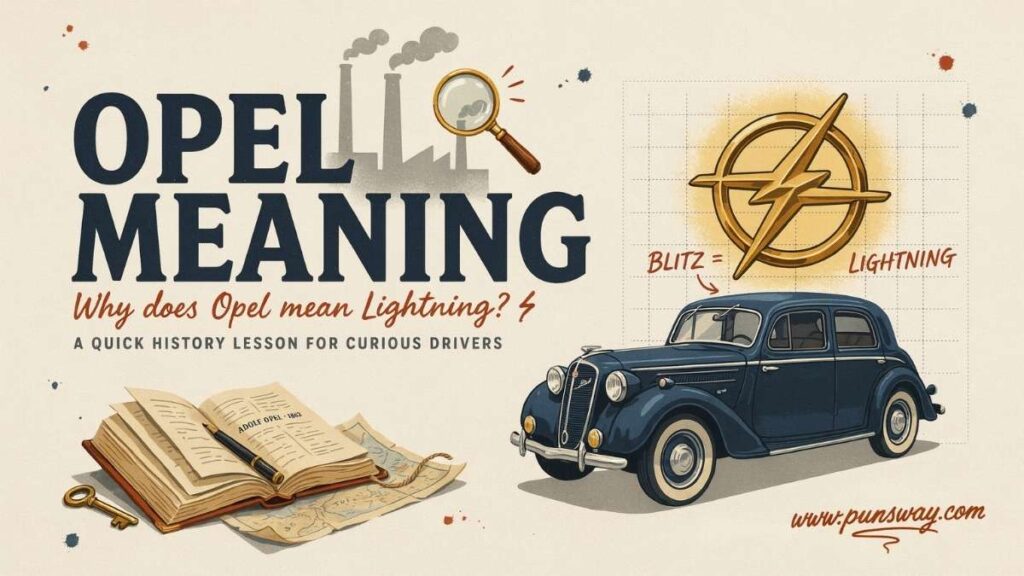
If you’ve searched for Opel meaning, you’re not alone. Every month, thousands of people look up the term for different reasons. Some want to know the history behind the famous Opel car brand. Others are curious about the Opel meaning in English, the origin of the Opel surname, or healthcare-related terms such as OPEL meaning NHS and Opel meaning hospital.
The answer isn’t as straightforward as many people expect.
In the automotive world, Opel is one of Germany’s most recognizable vehicle manufacturers with a history stretching back more than 160 years. In healthcare, however, OPEL has an entirely different meaning and serves as an important framework used by NHS hospitals to monitor operational pressures and patient demand. Meanwhile, linguistic discussions sometimes explore the Opel surname, its origins, and even alternative interpretations associated with the name.
This comprehensive guide explains what does Opel mean, where the name comes from, how it became a global automotive brand, and why the term appears in industries far beyond cars.
What Does Opel Mean?
At its core, Opel is a German surname that became internationally famous through the automotive company founded by Adam Opel in the nineteenth century.
Today, the name is most closely associated with the German automobile manufacturer headquartered in Rüsselsheim, Germany. Millions of drivers across Europe recognize Opel for its passenger cars, commercial vehicles, and growing lineup of electric vehicles.
However, the Opel word meaning depends heavily on context.
Someone researching German automotive history will encounter Opel as a vehicle manufacturer. A healthcare professional may recognize OPEL as an NHS operational framework. A genealogist might view Opel as a family name with German roots.
Opel Definition at a Glance
| Context | Meaning |
|---|---|
| Automotive Industry | German automobile manufacturer |
| Family Name | German surname |
| Healthcare | Operational Pressures Escalation Levels (OPEL) |
| Business | International automotive brand |
| Linguistics | Proper noun derived from a surname |
Because of these multiple uses, there is no single universal answer to what is the meaning of Opel. The intended meaning depends entirely on the context in which the term appears.
Opel Meaning in English
One of the most common questions online is: What does Opel mean in English?
Unlike many German words, Opel does not have a direct English translation.
Instead, it functions as a proper noun, meaning it identifies a specific person, family, company, or organization rather than describing an object or action.
In modern English usage, Opel usually refers to:
- The German automobile manufacturer
- The Opel family name
- The Opel vehicle brand
- The NHS OPEL framework in healthcare discussions
As a result, Opel meaning in English is not comparable to translating words such as “Haus” into “house” or “Wasser” into “water.” It remains the same in both languages because it is a name rather than a translatable vocabulary term.
Opel Name Origin and Etymology
Every famous brand starts with a name. In Opel’s case, that name belonged to a real person.
The Opel origin traces directly back to the Opel family of Germany. Long before automobiles existed, Opel was already an established surname.
Like many European surnames, the exact historical development of the name spans centuries. Records indicate that Opel emerged as a hereditary family name in German-speaking regions, eventually becoming associated with one of the country’s most successful industrial families.
Opel Surname Meaning
The Opel surname meaning differs from the meaning of a conventional dictionary word.
Rather than describing a specific object, place, or occupation, Opel primarily functions as a family identifier passed from generation to generation.
Over time, the surname gained international recognition because of the extraordinary commercial success of the company founded by Adam Opel.
Today, most people recognize Opel as a brand before they recognize it as a surname.
Opel Etymology
When discussing Opel etymology, researchers generally classify Opel as a German family name rather than a common German vocabulary term.
This distinction matters because many people searching for what does Opel mean in German language assume it is an ordinary German word with a literal translation.
In reality, Opel’s significance comes from its historical association with a family and a company rather than from a specific dictionary definition.
Who Was Adam Opel?
Behind every iconic brand stands a visionary founder. For Opel, that person was Adam Opel.
Born on May 9, 1837, Adam Opel grew up during a period of rapid industrial change in Germany. Fascinated by machinery and manufacturing, he trained as a locksmith before traveling throughout Europe to learn advanced production techniques.
Those experiences shaped his future.
After returning to Germany, he founded a manufacturing company in Rüsselsheim in 1862. Few could have predicted that this modest workshop would eventually become one of Europe’s most influential automotive brands.
Quick Facts About Adam Opel
| Fact | Details |
|---|---|
| Full Name | Adam Opel |
| Birth Date | May 9, 1837 |
| Death Date | September 8, 1895 |
| Nationality | German |
| Profession | Industrialist and Entrepreneur |
| Founded Company | Opel |
| Original Product | Sewing Machines |
| Headquarters Location | Rüsselsheim, Germany |
A fascinating detail often surprises readers: Adam Opel never built a car himself.
His company initially specialized in sewing machines and later expanded into bicycles. The transition into automobile manufacturing happened after his death when his sons recognized the enormous potential of the emerging automotive industry.
That decision transformed the Opel name from a regional surname into a globally recognized brand.
Is Opel a German Company?
Yes, Opel is unquestionably a German company.
The brand was founded in Germany, remains headquartered in Germany, and continues to play a major role in the country’s automotive sector.
For more than a century and a half, Opel has represented German engineering, industrial innovation, and practical vehicle design.
Today, the company’s headquarters remain in Rüsselsheim, a city that has become inseparable from Opel’s identity.
Why Opel Is Considered a German Brand
Several factors firmly establish Opel’s German heritage:
- Founded in Germany in 1862
- Headquarters located in Rüsselsheim
- Long history of German manufacturing
- Significant contribution to Germany’s industrial development
- Strong reputation for German engineering standards
When people ask what does Opel mean in German, they often expect a translated word. However, the more accurate answer is that Opel is a German surname that became synonymous with one of the country’s most successful industrial enterprises.
In many ways, the Opel story mirrors Germany’s own industrial rise. A small manufacturing workshop evolved into a major international company through innovation, persistence, and a willingness to embrace new technologies.
That journey remains one of the most remarkable business success stories in European history.
Opel History: How a Sewing Machine Company Became an Automotive Icon
Few names in the automotive world have a story as fascinating as Opel. Long before the company produced its first automobile, it built its reputation by manufacturing products that helped power everyday life across Germany.
Today, Opel stands among Europe’s most recognizable vehicle brands. However, its journey began in a small workshop, decades before the invention of modern cars.
Understanding Opel history helps explain why the brand remains an important part of the global automotive industry more than 160 years after its founding.
Fix common more word mistakes in English
Focussing or Focusing Which Spelling Is Correct?
From Opel Sewing Machines to Industrial Success
When Adam Opel established his company in 1862, automobiles were still a distant dream.
Instead, he focused on producing sewing machines, which were becoming increasingly valuable during the Industrial Revolution. Demand for reliable manufacturing equipment was growing rapidly, creating significant opportunities for innovative entrepreneurs.
Adam Opel recognized that opportunity early.
His company concentrated on building durable, high-quality sewing machines that offered reliability and precision. Customers responded positively, and the business expanded steadily throughout Germany.
Within a relatively short period, Opel had become one of the country’s most respected sewing machine manufacturers.
Why Opel’s Sewing Machine Business Thrived
Several factors contributed to Opel’s early success:
- Consistent product quality
- Modern manufacturing techniques
- Competitive pricing
- Strong customer trust
- Growing industrial demand
While most people now associate Opel with automobiles, the company’s first major success came from an entirely different industry.
Without the profits generated by sewing machines, Opel’s later expansion into bicycles and automobiles might never have happened.
Every automotive giant has an origin story. For Opel, that story began with steel, gears, and sewing machines rather than engines and wheels.
The Bicycle Boom That Accelerated Opel’s Growth
Before becoming a leading car manufacturer, Opel became a dominant force in the bicycle market.
In 1886, the company entered the rapidly growing bicycle industry. At the time, bicycles represented one of the most revolutionary forms of personal transportation available.
Demand surged throughout Europe.
Recognizing the potential, Opel invested heavily in bicycle production and quickly established itself as a market leader.
The move transformed the company.
By the end of the nineteenth century, Opel had become one of the world’s largest bicycle manufacturers, producing thousands of units annually and exporting products beyond Germany’s borders.
Why Opel Bicycles Became So Popular
| Success Factor | Impact on Growth |
|---|---|
| Efficient manufacturing | Lower production costs |
| Strong reputation | Increased customer confidence |
| Product innovation | Competitive advantage |
| Cycling sponsorships | Greater brand visibility |
| Expanding demand | Rapid sales growth |
The bicycle business did more than generate revenue. It taught Opel valuable lessons about mass production, supply chains, product engineering, and consumer behavior.
Those lessons would later prove invaluable when the company entered the automotive market.
Opel’s Entry Into Automobile Manufacturing
The automotive chapter of Opel’s story began after Adam Opel’s death in 1895.
His sons inherited the company and faced an important decision about its future direction.
At the turn of the century, automobiles represented a risky but promising new technology. Many business leaders remained skeptical about their long-term potential. The Opel family took a different view.
They believed the future belonged to motorized transportation.
In 1899, Opel introduced its first automobile, marking the beginning of a new era for the company.
Early Challenges in the Automotive Industry
The transition from bicycles to automobiles was far from easy.
Like every automotive pioneer of the era, Opel encountered numerous obstacles:
- High production costs
- Limited road infrastructure
- Evolving engineering standards
- Consumer uncertainty
- Increasing competition
Despite these challenges, the company continued investing in automotive development and gradually earned a reputation for quality and innovation.
What began as a bold experiment soon became the foundation of Opel’s future.
How Opel Became a Major European Car Brand
As the twentieth century progressed, Opel expanded rapidly.
Unlike some luxury-focused manufacturers, Opel concentrated on producing vehicles that ordinary families could afford. This strategy allowed the company to reach a much larger customer base.
The approach proved highly successful.
By combining practical engineering with competitive pricing, Opel became one of Germany’s most important automobile manufacturers.
The Shift Toward Mass Production
A pivotal moment arrived in 1924 when Opel introduced assembly-line production techniques.
This decision dramatically improved efficiency and reduced manufacturing costs.
The benefits were significant:
- Faster production times
- Lower vehicle prices
- Increased output
- Improved consistency
- Greater accessibility for consumers
The move positioned Opel at the forefront of European automotive manufacturing and helped establish the company as a leader in affordable transportation.
Key Milestones in Opel History
The company’s development can be traced through several landmark moments.
| Year | Milestone |
|---|---|
| 1862 | Adam Opel founds the company |
| 1886 | Bicycle production begins |
| 1899 | First automobile introduced |
| 1924 | Assembly-line manufacturing adopted |
| 1929 | General Motors acquires majority ownership |
| 2017 | PSA Group purchases Opel |
| 2021 | Opel becomes part of Stellantis |
Each milestone reflects a period of transformation that helped shape the modern Opel brand.
Who Owns Opel Today?
One of the most common questions surrounding the company is ownership.
Many people wonder whether Opel remains independent or belongs to a larger automotive group.
The answer lies in a series of major corporate transitions that reshaped the global automotive landscape.
The General Motors Era
A defining moment arrived in 1929 when General Motors acquired a majority stake in Opel.
The partnership provided Opel with access to global resources, advanced manufacturing expertise, and substantial investment capital.
Over the following decades, the relationship helped Opel strengthen its position across Europe.
Many of the company’s best-known vehicles emerged during the General Motors era.
Benefits of General Motors Ownership
- Increased investment
- Expanded engineering resources
- Greater manufacturing capacity
- International collaboration
- Access to advanced technologies
The partnership lasted nearly ninety years, making it one of the most significant periods in Opel’s corporate history.
The PSA Group Acquisition
In 2017, the automotive industry witnessed a major shift when PSA Group acquired Opel from General Motors.
The transaction represented one of the largest automotive acquisitions in Europe in recent years.
The deal reunited Opel with a primarily European ownership structure and created opportunities for increased cooperation with brands such as Peugeot and Citroën.
Industry analysts viewed the acquisition as a strategic move designed to improve efficiency and strengthen competitiveness throughout Europe.
Stellantis Opel: The Current Ownership Structure
Today, Opel operates under the umbrella of Stellantis, one of the world’s largest automotive manufacturers.
Stellantis was created in 2021 through the merger of PSA Group and Fiat Chrysler Automobiles.
The newly formed company oversees a remarkable collection of automotive brands, including:
- Opel
- Vauxhall
- Peugeot
- Citroën
- Jeep
- Fiat
- Chrysler
- Dodge
- Alfa Romeo
- Maserati
As a result, the answer to the frequently searched question “Is Opel owned by Stellantis?” is an unequivocal yes.
Opel now benefits from the resources, technology, and global reach of one of the automotive industry’s most powerful organizations.
What Does the Opel Logo Mean?
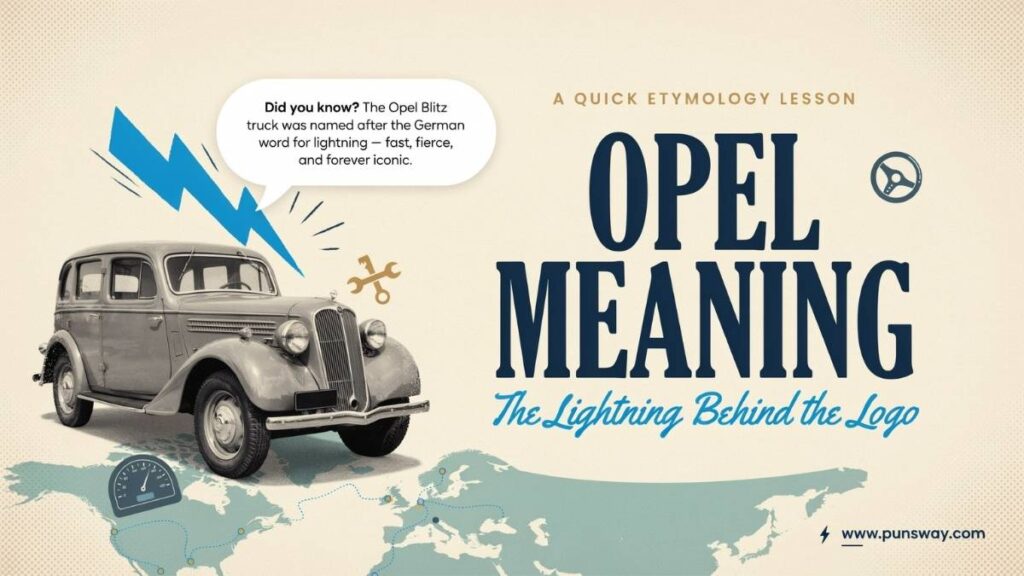
A logo often tells a company’s story without using a single word.
Opel’s emblem is among the most recognizable symbols in European automotive history.
The Meaning Behind the Lightning Bolt
The modern Opel logo features a lightning bolt enclosed within a circular ring.
The design symbolizes several key concepts:
- Speed
- Energy
- Innovation
- Engineering excellence
- Forward progress
The lightning bolt is commonly associated with the German word “Blitz,” meaning lightning.
Over time, this symbol became synonymous with Opel’s identity and helped establish a strong visual connection between the brand and technological advancement.
Fix common more word mistakes in English
Ingage vs Engage Difference and usage
Evolution of the Opel Logo
Although the logo has undergone multiple redesigns throughout the company’s history, one element has remained remarkably consistent: the lightning bolt.
Each redesign modernized the appearance while preserving the symbol’s core meaning.
This continuity strengthened brand recognition and ensured that Opel maintained a distinctive visual identity across generations.
Today, the lightning bolt remains one of the most recognizable automotive logos in Europe.
What Does Opel Stand For?
Many people assume Opel is an acronym.
It is not.
Unlike organizations whose names represent shortened phrases, Opel takes its name directly from its founder.
The Real Meaning Behind the Name
The Opel brand is named after Adam Opel.
The company’s name originated from his family surname and has remained unchanged since its founding.
This places Opel among a long tradition of automotive manufacturers named after their founders, including Ford, Ferrari, Bentley, and Porsche.
Common Misconceptions About Opel
People often believe Opel must be an abbreviation because:
- The name is short and memorable
- It sounds corporate in nature
- Many large organizations use acronyms
However, the reality is much simpler.
Opel does not officially stand for anything. It is a surname that became one of the most recognizable names in automotive history.
Opel’s Lasting Contribution to the Automotive Industry
Few manufacturers have influenced everyday transportation as significantly as Opel.
For more than a century, the company has focused on making reliable German engineering accessible to ordinary drivers.
That philosophy helped millions of people experience quality automotive technology without luxury-car pricing.
Areas Where Opel Made an Impact
- Affordable transportation
- Vehicle safety innovations
- Manufacturing efficiency
- Fuel economy improvements
- Electric mobility development
- Family vehicle design
By consistently balancing practicality, affordability, and innovation, Opel earned a reputation as one of Europe’s most trusted automotive brands.
Its influence continues today through both traditional vehicles and the company’s growing investment in electric mobility.
Popular Opel Models That Defined the Brand
Throughout its history, Opel has produced numerous vehicles that helped shape the European automotive market.
Some models became commercial successes. Others achieved iconic status among enthusiasts.
Together, they tell the story of Opel’s evolution as a manufacturer.
Opel Corsa
The Corsa remains one of Opel’s most successful vehicles.
Introduced in 1982, it quickly became a favorite among drivers seeking a compact, economical, and practical hatchback.
Opel Astra
The Astra succeeded the Kadett and became a cornerstone of Opel’s lineup.
Its blend of comfort, technology, and efficiency made it one of Europe’s most popular family cars.
Opel Kadett
Before the Astra, the Kadett helped establish Opel’s reputation for affordable transportation and played a major role in the company’s post-war growth.
Opel Insignia
The Insignia demonstrated Opel’s ability to compete in the mid-size segment by combining elegant design with everyday practicality.
Opel Manta
The Manta developed a cult following thanks to its sporty styling and distinctive personality.
Today, classic examples remain highly collectible.
Opel Zafira
The Zafira revolutionized family transportation with flexible seating configurations that maximized interior space and versatility.
Case Study: Why the Opel Corsa Became a European Bestseller
Few vehicles illustrate Opel’s strengths better than the Corsa.
The Market Challenge
European cities were becoming increasingly crowded. Drivers needed vehicles that were easy to park, economical to operate, and affordable to own.
Opel’s Solution
The company developed the Corsa specifically for urban environments while maintaining comfort and practicality.
The Outcome
The results exceeded expectations:
- Millions of units sold worldwide
- Strong brand loyalty
- Multiple successful generations
- Expansion into electric variants
- Continued popularity across Europe
The Corsa remains a textbook example of how understanding customer needs can create long-term automotive success.
Opel vs Vauxhall: Understanding the Relationship Between Two Iconic Brands
One of the most frequently asked questions about Opel concerns its connection to Vauxhall. At first glance, the two brands appear different. They have unique logos, distinct histories, and separate identities. Yet for decades, they have shared much more than most people realize.
The reality is simple: Opel and Vauxhall have traditionally sold many of the same vehicles under different brand names.
How Opel and Vauxhall Became Connected
For much of their modern history, both brands operated under the same corporate ownership. Opel primarily served continental Europe, while Vauxhall focused on the United Kingdom.
This arrangement allowed manufacturers to tailor branding to local markets while benefiting from shared engineering and production resources.
As a result, vehicles sold under the Opel badge in Germany, France, Spain, and other European countries often appeared in the United Kingdom as Vauxhall models.
What Opel and Vauxhall Shared
The two brands commonly shared:
- Vehicle platforms
- Engine technologies
- Safety systems
- Manufacturing facilities
- Research and development resources
- Design architecture
In many cases, the only visible difference was the badge attached to the vehicle.
| Opel Model | Equivalent Vauxhall Model |
|---|---|
| Opel Corsa | Vauxhall Corsa |
| Opel Astra | Vauxhall Astra |
| Opel Insignia | Vauxhall Insignia |
| Opel Mokka | Vauxhall Mokka |
Today, both brands operate under the umbrella of Stellantis, making their relationship even closer.
Opel Pronunciation: How Do You Pronounce Opel Correctly?
Many people know the brand but are uncertain about the correct Opel pronunciation.
The proper pronunciation is:
OH-pel
Phonetic spelling:
/ˈoʊ.pəl/
The first syllable sounds like the word “oh.” The second syllable sounds similar to “pull” but with a softer ending.
Common Pronunciation Mistakes
Because the name is German, English speakers occasionally pronounce it incorrectly.
Common mistakes include:
- Oh-peel
- Op-el
- O-paul
- O-pel-ay
The standard pronunciation used internationally remains OH-pel.
Learning the correct pronunciation is particularly useful when discussing the brand with automotive enthusiasts or researching its German origins.
Learn the difference between tricky more English words
Different or Diffrent Meaning, Spelling and Easy Examples
What Does Opel Mean in German?
Among the most searched questions online is “What does Opel mean in German?”
The answer surprises many people because Opel is not a traditional German vocabulary word.
Instead, Opel is primarily a German surname.
Opel German Meaning Explained
Unlike words such as Auto (car) or Haus (house), Opel does not function as a commonly used noun, adjective, or verb in everyday German conversation.
Instead, the name serves as:
- A family surname
- A company name
- A brand identity
- A historical reference to the Opel family
Because of this, there is no direct German-to-English translation.
When people search for Opel meaning in English or what does Opel mean in German language, they are usually seeking the origin of the name rather than a literal translation.
Is Opel a German Word?
Technically, Opel is better described as a German proper noun than a German dictionary word.
Its significance comes from history, heritage, and the industrial legacy of the Opel family rather than from a specific linguistic definition.
Opel Meaning Not Car: Other Uses of the Opel Name
Although most people immediately associate Opel with automobiles, the name has broader applications.
Searching for Opel meaning not car often leads to discussions about genealogy, healthcare, linguistics, and family history.
Opel as a German Surname
Before it became one of Europe’s most recognizable automotive brands, Opel existed as a family name.
The surname predates the company by generations and formed the foundation of the brand’s identity.
Today, surname researchers generally classify Opel as a German family name rather than a descriptive occupational surname.
Opel in Historical Records
The name also appears in:
- Family genealogy databases
- Historical documents
- Business records
- Academic research
- Linguistic studies
This wider usage explains why searches for Opel are not always related to vehicles.
Opel Meaning Slang: Does Opel Have an Informal Meaning?
Another common search query is Opel meaning slang.
In mainstream English, Opel does not have an officially recognized slang definition.
However, informal usage sometimes appears within automotive communities.
How Car Enthusiasts Use the Term
Depending on the region and community, Opel may be used informally to describe:
- Classic German cars
- Vintage European vehicles
- Opel enthusiasts and collectors
- Motorsport-related discussions
These uses are highly contextual and vary significantly between communities.
Is Opel a Slang Word?
For practical purposes, the answer is no.
Unlike terms that have established slang definitions in dictionaries or popular culture, Opel remains primarily known as a surname and automotive brand.
Most searches for Opel meaning slang stem from curiosity rather than the existence of a universally accepted slang interpretation.
Opel Meaning in Sanskrit
The phrase Opel meaning in Sanskrit has gained search popularity in recent years.
Historically speaking, Opel does not originate from Sanskrit. Its documented roots remain firmly connected to Germany and the Opel family name.
However, modern naming websites occasionally associate Opel with symbolic meanings linked to positive qualities.
Common Modern Interpretations
Some naming databases connect Opel with concepts such as:
- Jewel
- Precious stone
- Valuable treasure
- Something rare and cherished
These interpretations are generally modern associations rather than historically verified linguistic translations.
The Historically Verified Origin
When discussing Opel etymology, historians and researchers consistently point to its German surname origin.
Therefore, while Sanskrit-related interpretations may appear online, the established origin of Opel remains German.
Opel Meaning Hospital: Why Healthcare Professionals Use the Term OPEL
Outside the automotive world, the term OPEL takes on an entirely different meaning.
In healthcare environments, particularly within the United Kingdom, Opel meaning hospital refers to a structured framework used to monitor operational pressures and hospital capacity.
In this context, OPEL stands for:
Operational Pressures Escalation Levels
The healthcare meaning has no connection to the automobile manufacturer.
Instead, it serves as a practical management tool used by hospitals and healthcare administrators.
Why Hospitals Use OPEL
Modern healthcare systems face constant pressure from:
- Rising patient demand
- Seasonal illnesses
- Staffing shortages
- Emergency department congestion
- Capacity constraints
The OPEL framework provides a consistent method for measuring and responding to these challenges.
OPEL Meaning NHS: Understanding the NHS OPEL Framework
The term OPEL meaning NHS refers to one of the most important operational monitoring systems used across NHS organizations.
The NHS OPEL framework helps healthcare leaders understand how much pressure a hospital is experiencing at any given time.
Rather than relying on guesswork, administrators can use structured escalation levels to guide operational decisions.
What Is Operational Pressures Escalation Levels?
Operational Pressures Escalation Levels is a standardized framework designed to measure pressure across healthcare services.
The framework supports:
- Hospital capacity management
- Patient flow management
- Emergency care coordination
- Operational pressure monitoring
- Resource allocation decisions
The system creates a common language that allows healthcare organizations to communicate pressure levels clearly and consistently.
Why the OPEL Framework Matters
Hospitals operate in a constantly changing environment.
Patient numbers can rise unexpectedly. Emergency departments can become overcrowded. Bed availability can fluctuate rapidly.
The OPEL framework helps organizations:
- Identify risks early
- Escalate concerns appropriately
- Coordinate operational responses
- Protect patient safety
- Improve service delivery
This practical role explains the growing interest in Opel meaning in healthcare, OPEL NHS, and hospital escalation levels.
Understanding OPEL Levels in Hospitals
The NHS framework uses four escalation levels to indicate operational pressure.
Each level reflects a different degree of strain on healthcare services.
OPEL 1: Normal Operations
At OPEL 1, services function as expected.
Characteristics include:
- Stable patient flow
- Sufficient staffing
- Adequate bed availability
- Minimal operational concerns
OPEL 2: Moderate Pressure
Demand begins increasing and localized challenges may emerge.
Characteristics include:
- Growing patient numbers
- Early capacity concerns
- Increased monitoring
- Additional management oversight
OPEL 3: High Pressure
Significant operational challenges affect service delivery.
Characteristics include:
- High demand levels
- Capacity constraints
- Escalated management involvement
- Potential delays in patient flow
OPEL 4: Severe Operational Pressure
This represents the highest escalation level.
Characteristics include:
- Extreme demand
- Critical capacity shortages
- Organization-wide response measures
- Significant service pressures
OPEL Levels Overview
| OPEL Level | Operational Status | Typical Conditions |
|---|---|---|
| OPEL 1 | Normal | Stable operations |
| OPEL 2 | Moderate Pressure | Increased demand |
| OPEL 3 | High Pressure | Significant challenges |
| OPEL 4 | Severe Pressure | Critical operational strain |
Healthcare Case Study How OPEL Improves Patient Flow Management
Imagine a large NHS hospital during peak winter flu season.
Emergency department attendance rises sharply. Bed occupancy reaches near capacity. Staff face increasing workloads.
Without a structured escalation framework, coordinating a response becomes significantly more difficult.
The Challenge
The hospital experiences:
- Increased admissions
- Limited bed availability
- Longer waiting times
- Higher emergency department demand
- Greater pressure on clinical staff
The OPEL Framework Response
Using the NHS OPEL framework, hospital leaders can:
- Monitor operational conditions in real time
- Deploy additional resources
- Improve discharge coordination
- Increase staffing where possible
- Escalate concerns quickly
The Outcome
The framework improves situational awareness and supports faster decision-making during periods of high demand.
This practical application explains why Opel meaning in emergency medicine, Opel meaning in healthcare services, and Operational Pressures Escalation Levels have become increasingly important search topics.
Here’s a trusted source for clear word meanings:
The Future of Opel Electrification and Innovation
The automotive industry is experiencing its most significant transformation in more than a century.
Electric vehicles, connected technologies, sustainability initiatives, and digital mobility solutions are reshaping the future of transportation.
Opel is actively participating in this transformation.
Opel Electric Vehicles
As part of Stellantis’ long-term strategy, Opel continues expanding its portfolio of electric vehicles.
The company’s goals include:
- Greater electrification
- Reduced emissions
- Sustainable manufacturing
- Improved energy efficiency
- Advanced vehicle technologies
Several Opel models are already available in fully electric versions, reflecting the company’s commitment to a low-emission future.
Opel’s Long-Term Vision
Opel aims to strengthen its position as:
- A leading European car brand
- A modern electric vehicle manufacturer
- A technology-driven mobility company
- A sustainability-focused innovator
The transition toward electric mobility represents the latest chapter in a history defined by adaptation and innovation.
From sewing machines to bicycles, from automobiles to electric vehicles, Opel has consistently evolved alongside changing technologies and consumer expectations.
Learn how to use confusing more words correctly
Physics Fundamentals Guide and Touch of Humor
Practice Exercises
Test your knowledge of the Opel name, history, automotive legacy, and NHS healthcare meaning.
Fill in the Blanks
- Opel was founded by __________ in 1862.
- The company began as a manufacturer of __________ machines.
- Opel’s headquarters are located in __________, Germany.
- Opel entered the automobile industry in __________.
- The Opel brand is currently owned by __________.
- Opel is best known as a German __________ manufacturer.
- The Opel logo features a __________ bolt.
- Opel originally gained success through sewing machines and __________.
- The Opel Corsa is one of the company’s most popular __________.
- Opel and __________ historically sold similar vehicles in different markets.
- The name Opel comes from a German __________.
- Opel is not an automotive __________.
- OPEL in healthcare stands for Operational Pressures __________ Levels.
- OPEL is commonly used within __________ hospitals.
- OPEL 1 represents __________ operational conditions.
- OPEL 2 indicates __________ operational pressure.
- OPEL 3 represents __________ operational pressure.
- OPEL 4 indicates __________ operational pressure.
- Opel became part of Stellantis in __________.
- Adam Opel never personally built an __________.
- The German word “Blitz” means __________.
- Opel produces both traditional and __________ vehicles.
- The Opel Astra succeeded the Opel __________.
- Patient flow management is an important part of the NHS __________ framework.
- Opel is one of the most recognized __________ car brands.
Answers
- Adam Opel
- Sewing
- Rüsselsheim
- 1899
- Stellantis
- Automobile
- Lightning
- Bicycles
- Models
- Vauxhall
- Surname
- Acronym
- Escalation
- NHS
- Normal
- Moderate
- High
- Severe
- 2021
- Automobile
- Lightning
- Electric
- Kadett
- OPEL
- German
FAQs
What does Opel refer to?
Opel primarily refers to a German automobile manufacturer founded by Adam Opel in 1862. The name can also refer to the Opel family surname and, in healthcare settings, the NHS OPEL framework.
What does Opel stand for?
Opel does not stand for an acronym in the automotive industry. The company is named after its founder, Adam Opel.
What is an Opel?
An Opel is a vehicle produced by Opel, a German automotive brand known for passenger cars, electric vehicles, SUVs, and commercial vans.
What was Opel originally known for?
Before manufacturing automobiles, Opel produced sewing machines and later became one of the world’s largest bicycle manufacturers.
Who founded Opel?
Opel was founded by Adam Opel in Rüsselsheim, Germany, in 1862.
Is Opel a German company?
Yes. Opel is a German automobile manufacturer headquartered in Rüsselsheim, Germany, although it is now part of Stellantis.
What does Opel mean in English?
Opel does not have a direct English translation. It is a proper noun and surname that became famous through the automotive company founded by Adam Opel.
What does Opel mean in German?
Opel is primarily a German surname rather than a common German dictionary word. It is most commonly associated with the automotive brand.
What is the origin of the Opel name?
The Opel name originates from the Opel family surname, which became globally recognized through the success of the automotive company.
What is another name for Opel?
In the United Kingdom, Opel vehicles were historically sold under the Vauxhall brand, making Vauxhall the closest equivalent to Opel.
What is the English version of Opel?
There is no English-language version of Opel. However, Vauxhall served as Opel’s sister brand in the United Kingdom for many decades.
What is the American equivalent of Opel?
There is no direct American equivalent today. Historically, some Opel models shared platforms and technologies with vehicles produced by General Motors brands in North America.
Why is Opel not sold in the United States?
Opel withdrew from the U.S. market decades ago due to changing business strategies, market competition, and corporate restructuring within General Motors.
What does the Opel logo mean?
The Opel logo features a lightning bolt, often associated with speed, innovation, energy, and technological progress.
What is Opel known for?
Opel is known for producing affordable German-engineered vehicles, including popular models such as the Corsa, Astra, Insignia, and Mokka.
Is Opel owned by Stellantis?
Yes. Opel became part of Stellantis in 2021 following the merger of PSA Group and Fiat Chrysler Automobiles.
What is the relationship between Opel and Vauxhall?
Opel and Vauxhall have historically sold nearly identical vehicles under different brand names, with Opel serving continental Europe and Vauxhall serving the United Kingdom.
What does OPEL mean in NHS hospitals?
In NHS healthcare systems, OPEL stands for Operational Pressures Escalation Levels, a framework used to monitor hospital capacity and operational pressures.
What does OPEL 3 mean in hospitals?
OPEL 3 indicates high operational pressure, where hospitals experience significant demand challenges that require increased management oversight and escalation measures.
What does OPEL 4 mean in a hospital?
OPEL 4 is the highest escalation level and indicates severe operational pressure, often requiring organization-wide actions to manage patient demand and maintain safe services.
What is the purpose of the NHS OPEL framework?
The NHS OPEL framework helps hospitals monitor patient flow, manage capacity, identify operational risks, and coordinate responses during periods of increased demand.
Does Opel produce electric vehicles?
Yes. Opel manufactures several electric vehicles as part of its strategy to expand sustainable mobility and reduce emissions across its vehicle lineup.
Conclusion
If you searched for Opel meaning expecting a quick definition, you’ve probably realized that Opel is much more than a name on the back of a car.
At its heart, Opel is the surname of Adam Opel, the German entrepreneur whose small manufacturing business grew into one of Europe’s most respected automotive brands. What began with sewing machines in 1862 evolved into bicycles, automobiles, and eventually a modern lineup of innovative and electric vehicles. Few companies can claim a journey quite as remarkable.
Yet the story doesn’t stop at the automotive industry.
As you’ve learned, the Opel meaning in English is not a direct translation but a proper noun rooted in German history. The name appears in genealogy, branding, and even healthcare. In NHS settings, OPEL meaning NHS refers to Operational Pressures Escalation Levels, a vital framework used to monitor hospital capacity and patient demand. So, depending on the conversation, Opel might refer to a German car cruising down the highway or a hospital system helping manage patient care. That’s a plot twist most searchers don’t see coming.
One of the biggest sources of confusion is that people often assume Opel is an acronym, a German dictionary word, or a term with a single universal definition. In reality, the meaning depends entirely on context. Understanding that distinction clears up many of the misconceptions surrounding the name.

JHON AJS is an experienced blogger and the creative voice behind Puns Way. With a sharp sense of humor and a passion for wordplay, he crafts witty puns, lighthearted jokes, and clever content that keeps readers entertained. His goal is simple make people smile while turning everyday language into laughter.